
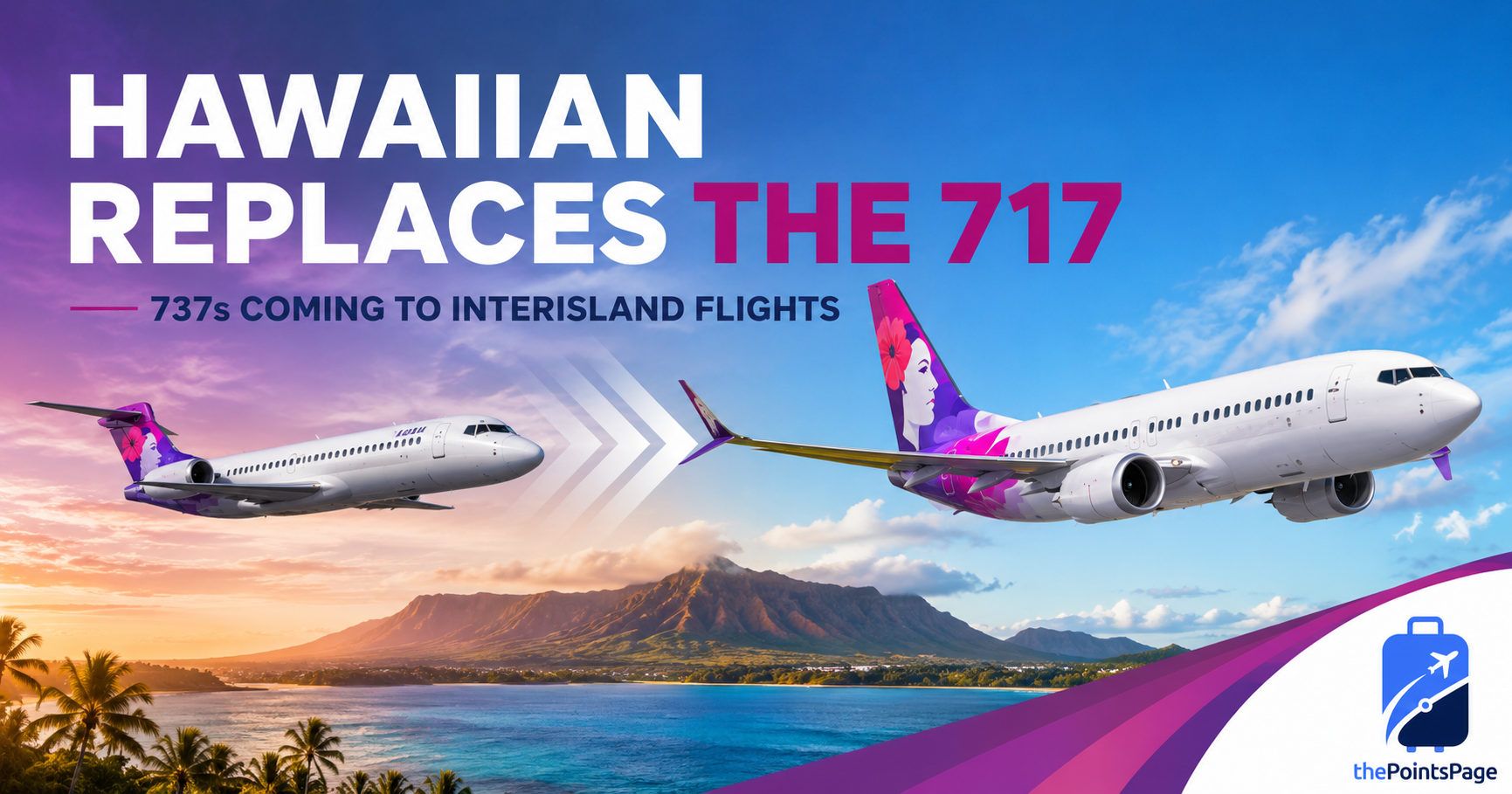
Quick Take: Hawaiian Airlines plans to begin replacing its Boeing 717 interisland fleet with Hawaiian-branded Boeing 737-800s in 2028. The larger aircraft will offer more premium seats, reclining Recaro seats, power outlets and fast, free Starlink Wi-Fi. Travelers will see a preview much sooner: beginning this October, an Alaska-branded 737 is scheduled to operate three daily round trips between Honolulu and Maui.
One of the most recognizable parts of flying between the Hawaiian Islands is approaching the end of its run.
Alaska Air Group has announced that Hawaiian Airlines will retire its Boeing 717 fleet and replace it with Hawaiian-branded Boeing 737-800 aircraft beginning in 2028.
The 717 has been the backbone of Hawaiian’s Neighbor Island operation for more than two decades. It is small, quick to load and unload, and particularly well suited to the repeated short flights that make up the airline’s interisland schedule.
The replacement aircraft will bring substantially more space, more premium seating, power and free Wi-Fi. At the same time, moving from a smaller 717 to a larger 737 will noticeably change an experience that many Hawai‘i residents and frequent visitors know extremely well.
What Hawaiian Airlines Announced
Hawaiian plans to begin transitioning its Neighbor Island operation from the Boeing 717 to the Boeing 737-800 in 2028.
The future aircraft will:
- Carry the Hawaiian Airlines brand and Pualani livery
- Be based in Honolulu
- Focus primarily on Neighbor Island flying
- Be flown by Honolulu-based pilots and flight attendants after operational integration is complete
- Include a larger First Class cabin and a new Premium Class section
- Offer fast, free Starlink Wi-Fi
- Provide power and device holders at every seat
Alaska says the goal is to begin the fleet transition in 2028 and move quickly once the change starts. A final retirement date for the last 717 has not been announced.
The company also has not yet published the exact number of 737-800s that will eventually be assigned to the Hawaiian interisland fleet.
A Preview Begins This October
Travelers will not need to wait until 2028 to see a 737 operating between the islands.
Beginning in October 2026, Alaska plans to base one Alaska-branded Boeing 737 in Honolulu. The aircraft is scheduled to operate three daily round trips between Honolulu and Kahului, Maui.
Those flights will supplement Hawaiian’s existing 717 service rather than immediately replace it.
Near-term test service:
- Route: Honolulu to Kahului, Maui
- Frequency: Three round trips per day
- Aircraft: Alaska-branded Boeing 737
- Expected start: October 2026
- Honolulu terminal: Terminal 1
That October service should give Alaska and Hawaiian an early opportunity to evaluate how the larger aircraft works within the fast-paced Neighbor Island operation before the dedicated Hawaiian-branded fleet arrives.
Passengers booked between Honolulu and Maui should check the aircraft type and operating carrier shown on their reservation, especially once the October schedule is loaded.
What Will Be Better on the 737?
The biggest passenger-facing improvements are fairly easy to identify.
More First Class and Premium Seats
Alaska says the 737-800 configuration will include twice as many First Class seats as the 717 and more than 30 Premium Class seats.
That should create more upgrade opportunities for Atmos Rewards members and eligible Huaka‘i by Hawaiian members, although complimentary upgrades will still depend on status, fare, route and availability.
More premium seats may also make it easier to purchase extra legroom without paying for First Class on a flight that may only last 30 to 45 minutes.
Free Starlink Wi-Fi
The future aircraft will include fast, free Starlink Wi-Fi.
Wi-Fi may seem unnecessary on such a short flight, but interisland travelers often fly for work, medical appointments, school, family obligations and same-day connections. The ability to remain online from gate to gate can still be useful.
It should also provide a more consistent connected experience for passengers arriving from or continuing to a mainland flight.
Power at Every Seat
The planned interior includes 110-volt power outlets, USB charging and seatback device holders at every seat.
Again, the individual flight is short. The larger benefit is that your phone or laptop does not need to lose more power during a travel day that may include several additional segments.
More Cargo Capacity
Alaska specifically highlighted additional room for surfboards.
The 737’s larger cargo hold should also provide more space for checked bags and commercial cargo, both of which are important in a market where air travel connects island communities as much as it serves vacationers.
Why Replace the Boeing 717?
Hawaiian’s 717s are more than 20 years old, and there is no current-generation replacement being produced.
The aircraft has been unusually well matched to Hawaiian’s operation because it can handle repeated short flights, quick turns and high daily cycle counts. A single aircraft may take off and land numerous times in one day while operating in a salt-air environment.
That combination is hard on aircraft.
Alaska says the 737-800 provides a durable and proven platform that can handle the high-cycle demands of the Neighbor Island network while increasing capacity.
Using 737-800s already available within the Alaska operation may also be more practical than introducing an entirely new aircraft type that would require a separate pilot group, maintenance operation, spare-parts inventory and training program.
Will Hawaiian Reduce Interisland Frequency?
Alaska says its objective is to sustain both frequency and capacity while meeting demand throughout the day.
That is reassuring, but the final schedule has not been published.
The 737 is larger than the 717. In theory, an airline can carry the same number of passengers using fewer flights when it moves to a larger aircraft. That does not mean Hawaiian has announced such a reduction, and the company is specifically saying that frequent service remains important.
Still, travelers should pay attention as the 2028 transition approaches.
For local passengers, frequency can matter more than the aircraft itself. A larger plane with Wi-Fi and power is helpful, but not when the tradeoff is fewer departure choices during the day.
No full 2028 schedule has been released. Hawaiian says it intends to maintain frequent service, but the exact number of aircraft, routes, daily departures and final transition timeline remain subject to planning. Do not assume today’s schedule will remain identical after the fleet change.
Will Boarding Take Longer?
Probably—but how much it matters will depend on how Hawaiian manages the operation.
The 717 is smaller and has fewer passengers to board. A 737-800 has a longer cabin, more seats and potentially more carry-on bags.
On a traditional two-hour flight, an extra few minutes of boarding may not feel meaningful. On a route where the flight itself can be shorter than the boarding process, efficiency becomes much more noticeable.
Hawaiian and Alaska will need to preserve quick turns if they want the larger aircraft to support the high-frequency schedule travelers expect.
The October Honolulu-Maui service should offer an early look at gate operations, boarding times and passenger flow with a 737.
What Happens to the Hawaiian Brand?
The replacement aircraft will eventually be painted in Hawaiian Airlines colors and carry the Pualani tail.
Alaska says the aircraft will be based in Honolulu and operated by Honolulu-based crews after the airlines complete the relevant operational integration.
This is part of the combined company’s dual-brand strategy. Alaska Airlines continues as one consumer-facing brand, while Hawaiian remains the brand associated with flying to, from and within Hawai‘i.
That distinction has been important since Alaska completed its acquisition of Hawaiian. For many residents, Hawaiian Airlines is not simply another airline serving a leisure destination; it is part of the transportation infrastructure connecting the islands.
The company is therefore trying to modernize the fleet without making the Neighbor Island operation feel like a generic extension of Alaska’s mainland network.
There Is Already Some Employee Pushback
The Association of Flight Attendants representing Alaska Airlines crews criticized the plan to introduce an Alaska-branded 737 on Honolulu-Maui flights before the full operational integration is complete.
The union argues that the immediate use of an Alaska aircraft and Alaska crews is inconsistent with earlier expectations surrounding the preservation of Hawaiian’s operational presence.
Alaska’s public announcement says the permanent Hawaiian-branded fleet will eventually be flown by Honolulu-based pilots and flight attendants after integration is complete.
How that transition is handled could remain a sensitive labor issue, particularly before the dedicated Hawaiian-branded aircraft and local crewing plan are in place.
For passengers, the most immediate effect is simply that some October Honolulu-Maui flights may be operated by an Alaska aircraft and crew even though the long-term plan centers on Hawaiian-branded planes and Honolulu-based employees.
What This Means for Atmos Rewards Members
Members should continue earning and redeeming through Atmos Rewards under the combined Alaska-Hawaiian loyalty structure.
The larger premium cabins could create:
- More First Class award seats
- More opportunities to purchase Premium Class
- More space for complimentary elite upgrades
- More capacity during popular travel periods
That does not guarantee inexpensive awards or easy upgrades. Interisland award pricing and availability will still depend on demand, date, flight and fare inventory.
Travelers should compare the cash fare with the points price before redeeming. Short interisland tickets can sometimes be inexpensive enough that paying cash and saving points for a more valuable trip makes more sense.
Want Some Free Help?
Use the Points & Miles Bonus Calculator when you need to compare transfer or earning math, and organize multi-island travel with the Travel Planning Checklist.
Don't Forget About Separate Island Connections
Many visitors use an interisland flight to connect from a mainland or international itinerary to a separate island stay.
When those flights are booked on separate tickets, a delay on the first itinerary may not obligate the second airline or ticketing program to protect the connection.
Consider leaving additional time when:
- Your interisland flight is on a separate reservation
- You are connecting to the last flight of the evening
- You are traveling with checked luggage
- You have a cruise, tour or nonrefundable hotel reservation
- Your trip falls during a major holiday or busy school break
A schedule with more available seats can help, but it does not eliminate the risk of a missed separate-ticket connection.
Review Your Current Coverage
The Credit Card Coverage Tool can help identify where card protections may be limited, while the Travel Insurance Fit Check Tool can help you think through whether a broader travel insurance policy is worth comparing.
Getting to the Point(s)
Hawaiian’s Boeing 717 retirement will mark the end of a distinctive chapter in interisland travel.
The 737-800 brings clear passenger improvements: more First Class and extra-legroom seats, free Starlink Wi-Fi, power at every seat, modern interiors and additional cargo capacity.
The bigger aircraft also creates legitimate questions about boarding time, schedule frequency and whether the highly efficient feel of Hawaiian’s existing Neighbor Island operation can be preserved.
The full transition does not begin until 2028, and many important details—including the final fleet size, complete route schedule and last 717 flight—remain unknown.
For now, the first thing to watch is the Honolulu-Maui route this October. Those three daily Alaska-operated round trips should provide an early preview of what a larger 737 looks like on one of the shortest and busiest types of flights in the United States.
Planning a Multi-Island Hawai‘i Trip?
Separate tickets, short connections, checked bags and changing flight schedules can make island-hopping more complicated than it looks. Use thePointsPage planning tools before you transfer points or commit to nonrefundable reservations.
Sources & Further Reading
- MilesFeed: Current points, miles and travel headlines
- Alaska Airlines: Official Neighbor Island fleet announcement
- The Points Guy: Hawaiian Airlines to phase out the Boeing 717
- Association of Flight Attendants: Response to the interim 737 operation
- Alaska and Hawaiian Airlines Newsroom
- Hawaiian Airlines
- thePointsPage Travel and Rewards Tools
Aircraft assignments, onboard features, operating carriers, schedules, upgrade availability and transition dates can change. Confirm the aircraft and operating carrier shown on your reservation before travel. Travel insurance and credit-card benefits vary by policy, card, payment method and the specific cause of a disruption.