
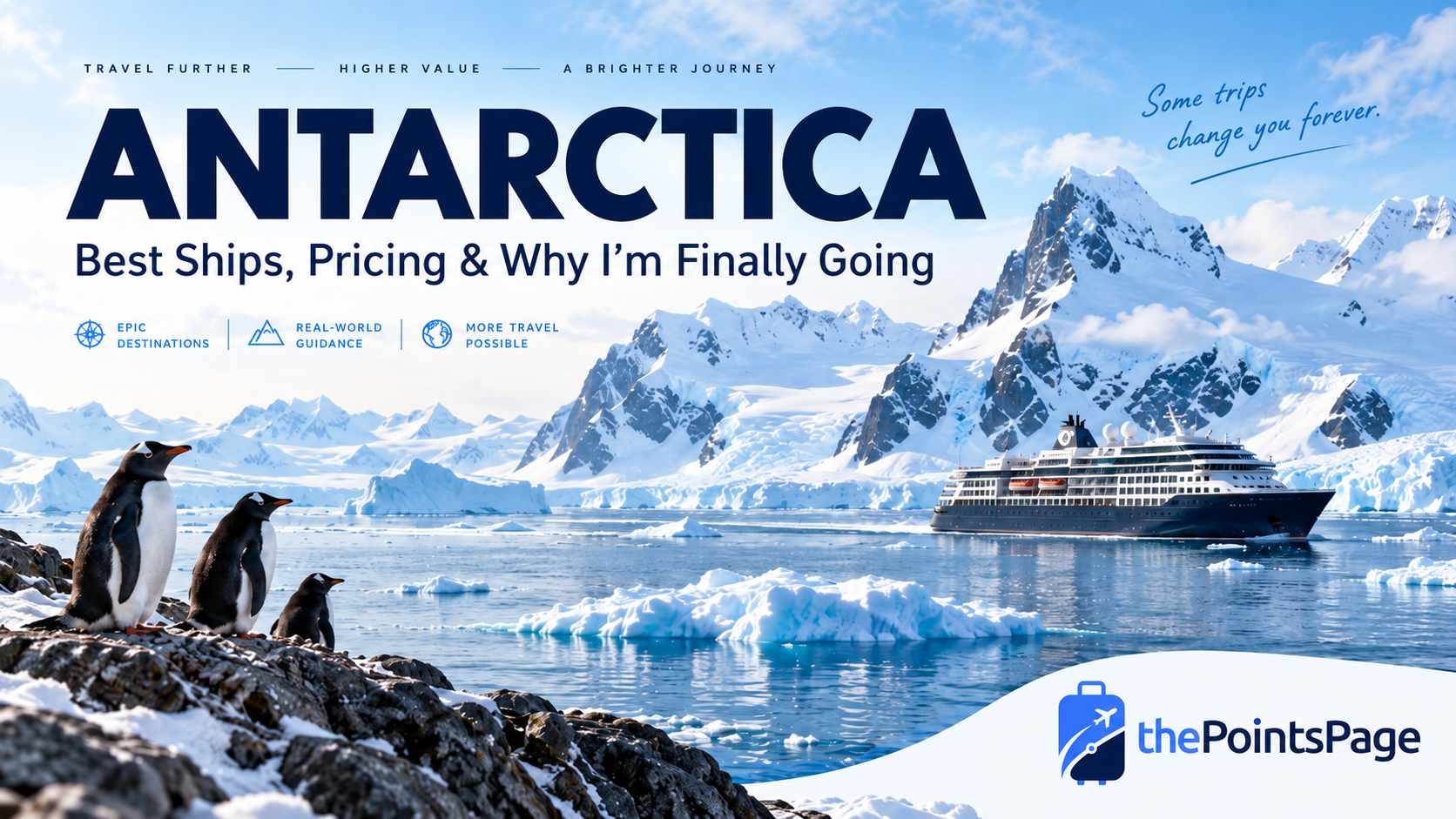
There's a personal side to this trip, too: Antarctica is the one continent I haven't visited yet, so assuming everything goes according to plan, I'll finally be joining the all-seven-continents club.
Antarctica is one of those trips I've looked at plenty of times over the years without ever getting serious enough to actually book it. Part of that is simply because it's expensive. There really isn't a cheap and easy version of getting to the bottom of the world, especially if you want to actually step onto the continent instead of just sailing past it on a large cruise ship. Add in the cost of getting to South America, the expedition itself, insurance, gear and everything else surrounding the trip, and the total can get pretty ridiculous in a hurry.
But Antarctica is also unlike just about anywhere else you can travel. There aren't cities where you can pick between a dozen Hyatt properties, there isn't a rental car waiting for you at the airport, and you aren't building an itinerary around restaurant reservations and tourist attractions. Your schedule can change because of weather, sea conditions, ice or wildlife, and you're essentially relying on the expedition team to figure out what the continent is going to allow you to do that day. For someone who spends a lot of time planning travel down to the details, there's actually something pretty appealing about that.
The other thing I quickly learned while researching this trip is that saying you're “going to Antarctica” doesn't tell us very much about the actual trip. You could sail past the continent on a traditional cruise ship for several thousand dollars, take a small expedition ship across the Drake Passage and make landings, fly over the Drake and join a ship once you're already there, or skip the cruise completely and fly into the Antarctic interior for an experience that can easily cost more than $100,000. There are a lot more choices than I originally realized, and the right one really comes down to what you want out of the trip.
Why I Finally Booked Antarctica
For me, the tipping point wasn't suddenly deciding that I had to visit Antarctica this year. I've wanted to go for a while. What changed was the price, and more specifically, the way HX was pricing my trip as a solo traveler.
If you've ever priced cruises by yourself, you already know where this is going. Most cabins are designed and priced around two people sharing them, which means a solo traveler can end up paying a single supplement to make up for the second passenger who isn't there. Depending on the cruise and cabin, that surcharge can be substantial enough to kill an otherwise decent deal.
That was the part of Antarctica pricing that kept bothering me. I'm perfectly fine paying for a bucket-list experience, but paying thousands of dollars extra simply because I'm occupying the cabin alone isn't exactly the kind of “value” I normally get excited about.
Expedition: Highlights of Antarctica
Ship: HX Expeditions MS Roald Amundsen
Ship itinerary: 11 days
Route: Ushuaia → Antarctica → Ushuaia
Departure: January 2027
Accommodation: Outside expedition cabin
Original package fare: $16,973.26
Promotional discount: -$2,630.73
Additional discount: -$717.10
Solo supplement waiver: -$3,730.43
Final price: $9,895
Once HX removed the single supplement, the math changed pretty dramatically. The waiver took $3,730.43 off the trip by itself, and the two other promotions brought the total discount to $7,078.26. Instead of looking at nearly $17,000, I was looking at $9,895 for the package. I'm not going to pretend $9,895 is cheap, because it certainly isn't, but we're talking about Antarctica here. Compared with the alternatives I had been researching, that became a much more compelling number.
There's more included here than simply an 11-day cabin on a ship, too. My package includes a pre-cruise hotel in Buenos Aires, transfers and flights between Buenos Aires and Ushuaia tied to the expedition, along with the onboard meals, beverages and included expedition activities. That matters when you're comparing prices because Antarctica cruise websites can make two trips look relatively close in price when one operator includes a lot of the surrounding logistics and the other doesn't.
I also wasn't trying to find the cheapest possible way to technically say that I've been to Antarctica. If I'm going that far, I want to actually experience it. I want the Zodiac rides, landings, wildlife, expedition staff and the opportunity to spend several days exploring around the Antarctic Peninsula. Whether I ever make it back a second time remains to be seen, so I didn't want my first trip to amount to standing on the deck of a large cruise ship and looking at Antarctica through binoculars.
And then there's probably the biggest personal reason for going. I've been fortunate enough to travel to a lot of places over the years, but Antarctica is still missing from the list. Once I get there, I'll finally have visited all seven continents. That doesn't change the value calculation or make the cruise any cheaper, but it definitely makes this particular trip feel a little different than another vacation on the calendar.
First Things First: There Are Several Ways to Visit Antarctica
One of the biggest things I learned while researching this trip is that Antarctica isn't one product. When someone says they took an Antarctica cruise, you really need another couple questions before you know what kind of experience they had. Did they actually get off the ship? Did they cross the Drake Passage? How many passengers were onboard? Was it a traditional expedition cruise, or were they on a larger ship doing scenic cruising?
Those differences matter quite a bit, so before worrying about which cruise line or ship is “best,” I'd start by deciding which type of Antarctica trip makes the most sense for you.
1. Scenic Cruising on a Larger Ship
This is generally the least expensive and most familiar option for someone who already enjoys traditional cruising. Larger cruise ships can sail into Antarctic waters and give passengers some incredible views from the ship, but vessels carrying more than 500 passengers aren't permitted to make passenger landings in Antarctica. In other words, you can absolutely see Antarctica this way, but you're not getting the same experience as the smaller expedition ships that are putting guests into Zodiacs and taking them ashore.
That distinction doesn't automatically make scenic cruising bad. For someone who doesn't care about stepping onto the continent, prefers a larger ship with more restaurants and entertainment, or simply wants to experience the scenery at a lower cost, it can make plenty of sense. Traditional cruise lines periodically offer longer South America itineraries that include Antarctic scenic cruising, and depending on the cabin and promotion, these can start at only several thousand dollars per person.
For me, though, this option was pretty easy to eliminate. If Antarctica is going to be my seventh continent, I want my feet on it.
2. The Traditional Expedition Cruise Across the Drake Passage
This is probably what most people picture when they start seriously researching an Antarctica trip, and it's the route I ultimately booked. You normally begin in Ushuaia at the southern end of Argentina, board an ice-capable expedition ship and spend roughly two days crossing the Drake Passage before reaching the Antarctic Peninsula.
Once you arrive, the ship becomes more of a floating base camp than a traditional cruise ship. Instead of pulling into a port, walking off the gangway and wandering around town, the expedition team is looking at weather, ice and wildlife conditions to decide where you can safely go. A typical day might involve a Zodiac cruise through ice in the morning and a landing near a penguin colony later in the day. Another day might get rearranged completely because conditions changed overnight.
For a normal 10- to 12-day Peninsula expedition, a reasonable starting point is often somewhere around $9,000 to $15,000 per person. From there, pricing can go much higher depending on the ship, cabin, itinerary and level of luxury. That range is exactly why my $9,895 HX package got my attention. It put me toward the lower end of what I was seeing for a true expedition experience, especially once I factored in the other inclusions.
3. Fly Over the Drake Passage
Now, what if the part of Antarctica you're least excited about is spending two days in each direction crossing a body of water famous for making people miserable?
Well, you can skip it.
Several operators offer fly-cruise programs where you travel to southern Chile and fly across the Drake Passage to King George Island in the South Shetland Islands. You then board your expedition ship in Antarctica rather than sailing all the way down from South America.
The obvious advantage is time. Instead of spending roughly four days of your trip sailing across the Drake and back, more of your vacation can be spent around Antarctica itself. It can also be extremely appealing to someone who knows they're prone to serious seasickness and doesn't want the Drake Passage hanging over the entire trip.
The downside shouldn't surprise anyone: convenience costs money. These trips commonly land in the $15,000 to $25,000+ range per person, and luxury versions can go substantially higher. If your vacation time is limited or avoiding the Drake is a priority, that extra cost may be completely justified. For me, the traditional crossing was part of the experience I wanted.
4. Sail One Direction and Fly the Other
There's also a middle ground that I think is pretty interesting. Some itineraries let you cross the Drake Passage aboard the ship in one direction and fly in the other. You still get the experience of crossing the Drake, but you only have to do it once, and the trip can usually be shortened by a couple days.
If I were particularly worried about seasickness but still wanted to say I'd crossed the Drake, this is probably where I'd start looking. It's also useful for someone who wants a real expedition trip but can't devote 11 or 12 days to the cruise portion alone.
5. Small Yachts and Micro-Expeditions
If 200 passengers already sounds like too many people, there are even smaller options. IAATO has a separate yacht classification for sailing and motor yachts carrying no more than 12 passengers, and these can provide an incredibly intimate way to experience the region.
Don't assume tiny automatically means cheap, though. These are specialized trips with very limited capacity, so pricing can still be significant. The appeal is really about access, flexibility and having a completely different expedition experience than you'd get aboard a traditional cruise ship.
6. Fly Into the Antarctic Interior
Finally, we get to the “well, technically there's another option” category. You can skip expedition cruising entirely and fly into the Antarctic interior. Specialist operators run trips from places such as Cape Town to remote camps in Antarctica, with experiences that can include Emperor penguin colonies, mountaineering and even the Geographic South Pole.
This is a completely different trip from what I'm doing and a completely different price range, too. High-end interior expeditions can run from roughly $65,000 to well over $100,000 per person, and even shorter fly-in experiences can cost well into five figures. Fascinating? Absolutely. In my budget for January? Not so much.
The Antarctica Rule That Makes Ship Size So Important
When we're comparing normal cruises, I usually look at ship size as a matter of preference. Some people love huge ships loaded with restaurants, pools and entertainment, while others would rather have something quieter and smaller. Antarctica changes that conversation because passenger count can directly affect what you're able to do once you get there.
Ships carrying more than 500 passengers cannot make passenger landings in Antarctica. Ships that do make landings can have no more than 100 visitors ashore at one landing site at a time, and vessels carrying 201–500 passengers are subject to additional restrictions on landing activities.
This means a 138-passenger ship and a 490-passenger ship can both be legitimate Antarctica expedition vessels, but the experience of moving everyone on and off the ship is going to be different. With fewer guests onboard, you have fewer people to cycle through Zodiac groups and shore landings. That's a real advantage if maximizing time off the ship is your top priority.
The larger expedition ships aren't automatically worse, though. They usually have more public space, more dining choices, larger fitness and wellness areas and, depending on the operator, potentially better pricing. My own ship, MS Roald Amundsen, carries up to 490 guests, so it's definitely on the larger end of the expedition category. I knew that before booking, and if price were completely irrelevant I'd probably lean toward a smaller ship. Unfortunately, price tends to be pretty relevant in the real world.
That's why I wouldn't choose an Antarctica ship by passenger count alone. I'd look at passenger count, itinerary, expedition program, ship capabilities and price together. You're looking for the combination that fits what you actually care about.
The Antarctica Expedition Ships I'd Put Near the Top of the List
Calling anything the “best” cruise ship is always going to be subjective, and Antarctica makes that even more obvious. Someone who's willing to spend heavily for extreme luxury is going to rank these ships very differently than someone trying to maximize time ashore or someone like me who finds a promotion that changes the value equation.
With that in mind, I'm ranking these based on the overall expedition product: passenger count, polar capability, activities, infrastructure, onboard expertise, comfort and, to some degree, what you're getting for the money. This isn't a ranking of which ship has the fanciest suite or best steakhouse.
#1 — National Geographic Endurance / National Geographic Resolution
Best for: A serious expedition experience with a very small passenger count
If price weren't part of the conversation and I were choosing strictly based on the expedition experience, these would be extremely high on my list. National Geographic Endurance and Resolution each carry only 138 guests, which is a very attractive number in Antarctica. They're also purpose-built PC5 polar ships rather than traditional cruise ships that happen to operate in cold weather.
What really stands out to me, though, is the emphasis on the destination. Lindblad/National Geographic builds the product around naturalists, photography, wildlife, science and education, which is exactly what I'd want if I were spending this much money to travel somewhere as unique as Antarctica. The small number of passengers should also make getting people into Zodiacs and ashore easier than it would be on one of the larger expedition vessels.
Why I'd choose it: if the primary goal is maximizing the actual Antarctica experience rather than the traditional cruise experience, this is probably my favorite overall combination.
#2 — Le Commandant Charcot
Best for: Extreme polar capability with luxury attached
PONANT's Le Commandant Charcot is almost unfair to compare with some of the other ships on this list because it was designed to operate in conditions that normal Antarctica expedition vessels simply aren't built for. Its Polar Class 2 rating gives it substantially greater ice capability than the PC5 and PC6 ships you're commonly going to find on Peninsula itineraries.
It carries up to 245 guests, so you're still looking at a relatively modest passenger count, but you're combining that expedition capability with a much more luxurious French onboard product. This is the kind of ship I'd be researching if the itinerary involved destinations or ice conditions that required something beyond the normal Antarctica Peninsula route.
Why I'd choose it: you're not simply looking for a nice ship in Antarctica; you're looking for one of the most capable passenger vessels operating there and you're willing to pay accordingly.
#3 — Silver Endeavour
Best for: An Antarctica expedition without giving up luxury
Silver Endeavour carries around 220 guests and brings the Silversea version of luxury into the expedition market. We're talking all-suite accommodations, high-end service and the type of onboard experience you'd expect from a luxury cruise line, except now you're putting on expedition gear and getting into a Zodiac to go see penguins.
This is an appealing option for someone who wants a true expedition rather than a scenic cruise but isn't interested in the more utilitarian feel that some polar vessels can have. There's absolutely nothing wrong with wanting to spend the day climbing in and out of Zodiacs and then coming back to a much nicer dinner and suite afterward.
Why I'd choose it: you want Antarctica to be an adventure during the day and a luxury vacation again once you're back onboard.
#4 — Quark Ultramarine
Best for: The traveler who wants to do as much as possible
Ultramarine may be one of the more interesting ships on this list because Quark clearly designed it around getting people off the ship. It carries only 199 guests, has 20 quick-launching Zodiacs and, most unusually, carries two twin-engine helicopters.
Those helicopters aren't just there to make the ship look cool in pictures. Depending on the voyage and conditions, they create opportunities for flightseeing and helicopter-supported activities that simply aren't available from most other Antarctica ships. Combine that with the smaller passenger count and Quark's long history in polar travel, and this feels like one of the strongest choices for someone who cares more about adventure than traditional cruise amenities.
Why I'd choose it: if I'm spending this much money to get to Antarctica and my attitude is “how much can we possibly do while we're here?”, Ultramarine makes a lot of sense.
#5 — Seabourn Venture / Seabourn Pursuit
Best for: A really good balance between expedition and traditional luxury cruising
Seabourn's Venture and Pursuit each carry around 264 guests and are purpose-built expedition vessels with PC6 ratings. What I like about them is that the expedition side doesn't feel like an afterthought. You still get Zodiacs, kayaks and a real expedition program, but it's wrapped inside the food, suites and service that Seabourn guests are expecting.
This may be the easiest recommendation for someone who has cruised premium or luxury lines before and is hesitant about whether an expedition ship is going to feel too basic. You're definitely going on an expedition, but you don't have to abandon the cruise experience you already enjoy to do it.
#6 — Viking Octantis / Viking Polaris
Best for: Science, enrichment and a comfortable ship
Viking's Octantis and Polaris carry 378 guests, putting them in the middle of the expedition-ship spectrum. The reason I'd consider them is less about having the smallest ship and more about the onboard design and science program. The vessels include laboratories, extensive observation spaces and Viking's enclosed Hangar, which makes boarding smaller expedition craft a little more civilized when the weather isn't cooperating.
Viking also leans heavily into education and scientific programming, which feels like a natural fit for Antarctica. If you're the type of traveler who actually enjoys the lectures and wants to know what you're looking at instead of simply taking the photo and moving on, that aspect of the trip may matter quite a bit.
#7 — HX MS Roald Amundsen / MS Fridtjof Nansen
Best for: Finding a strong expedition value when HX runs the right promotion
And here we are at the ship I actually booked.
MS Roald Amundsen carries up to 490 passengers, so I'm not going to pretend it's the ship I'd choose if my only goal were having the fewest possible people onboard. It's near the maximum size for a ship that can still conduct Antarctica landings, and because only 100 visitors can be ashore at a site at one time, there will obviously be some cycling of groups during the trip.
That said, the ship was purpose-built for polar expeditions, uses hybrid propulsion, has a large Science Center and offers a comfortable Scandinavian-style onboard product. HX also includes quite a bit in the package compared with some competitors, which becomes important when you start comparing the actual final cost instead of just whatever number shows up first on a cruise search.
Most importantly, this is where value won out for me. I can look at National Geographic Endurance and say I'd prefer 138 passengers instead of 490, but if doing that means adding thousands and thousands of dollars to the trip, the decision gets more complicated. At $9,895 with the solo supplement completely removed, Roald Amundsen gave me the itinerary I wanted at a price I could justify.
That's something I think gets lost when people make “best of” lists. The best product on paper isn't always the best booking for the person actually paying the bill.
How Much Does a Trip to Antarctica Actually Cost?
This is probably the question most people want answered before getting too deep into researching ships, and unfortunately the answer is everyone's favorite: it depends. The type of trip, length, time of season, cabin, ship size, level of luxury and whether you're traveling solo can move the price dramatically.
Still, I think it's helpful to have some general ranges in mind before you start shopping:
| Type of Trip | Rough Price Range | Best For |
|---|---|---|
| Large-ship scenic cruising | Several thousand dollars+ | Seeing Antarctica at a lower cost without making landings |
| Classic expedition cruise | $9,000–$15,000+ | Most first-time travelers who want to step onto Antarctica |
| Premium / luxury expedition | $15,000–$30,000+ | Combining an expedition with higher-end accommodations and service |
| Fly-cruise | $15,000–$25,000+ | Saving time or avoiding most of the Drake Passage |
| South Georgia / Falklands combinations | $20,000–$50,000+ | Longer wildlife-focused trips |
| Antarctic interior / South Pole | $65,000–$115,000+ | Very specialized interior and bucket-list expeditions |
These are broad planning ranges rather than live quotes. Cabin category, trip length, departure date, solo supplements and promotions can change the price substantially.
You'll also want to pay attention to what's actually included before deciding one cruise is cheaper than another. Does the price include hotels? Charter or domestic flights? Transfers? Alcohol? Expedition gear? Activities? Internet? Gratuities? A $10,000 package that takes care of several surrounding expenses may very well be a better deal than an $8,500 cruise fare that leaves you paying separately for half the trip.
If You're Traveling Solo, Watch the Supplement More Than the Sale Percentage
This is probably the biggest takeaway from my own booking, and it's one I'd pay very close attention to if you're considering Antarctica by yourself.
We're all trained to react to the big percentage on the advertisement. “20% off Antarctica!” certainly sounds good. But if you're a solo traveler and the operator is still charging you several thousand dollars for occupying the cabin alone, a smaller sale combined with a waived supplement could end up being a much better deal.
That's exactly what happened to me. HX removing $3,730.43 in solo charges mattered more than seeing another generic percentage-off sale. Once the additional promotions stacked with it, I was looking at roughly 42% off the original package price.
This doesn't mean you should wait until the last minute assuming the solo supplement will disappear. There's obviously a tradeoff. The sailing you want could sell out, airfare could get more expensive, or the cabin category you wanted could disappear before the promotion ever shows up. But if you're flexible on dates and operators, I'd absolutely keep an eye on solo promotions rather than assuming the first price you see is the price you'll eventually need to pay.
Why I'm Going in January
My sailing leaves in January, which puts the trip right in the middle of the Antarctic summer. December and January bring long daylight hours, comparatively milder temperatures and very active penguin colonies. This is also the period when chicks are hatching and growing, which obviously doesn't hurt the photo opportunities.
If whales were my absolute number-one priority, I'd probably lean a little later in the season toward February or March when whale activity generally becomes more prominent. But for my first trip, January feels like a really good middle ground. I should get plenty of daylight, active wildlife, decent access around the Peninsula and some of the better overall conditions of the season.
Of course, we're still talking about Antarctica. “Better conditions” doesn't mean you're packing shorts.
There’s also onnneeeee more reason the timing of this trip feels especially right. Just three days after the cruise ends is when I get to hit another massive milestone in life - my 40th trip around the Sun! If I’m going to mark a milestone birthday like this with something memorable, finishing my seventh continent and spending nearly two weeks in Antarctica feels pretty tough to beat. The solo pricing is what made the numbers work, but the timing is what made this feel like the right year to finally do it.
If you've read this far, please drop me a note in our
Facebook Group, or scroll to the comments section at the bottom of this page and leave one there!
About That Drake Passage...
It doesn't take long to research Antarctica before you run into two phrases: Drake Lake and Drake Shake. They're both describing the roughly 600-mile stretch of water between South America and Antarctica; the nickname you end up using apparently depends on what the ocean decides to do while you're crossing it.
On a good crossing, the Drake can be surprisingly calm. On a bad one, it's one of the most famously rough stretches of ocean in the world. Modern expedition ships have stabilizers and are obviously much more comfortable than the ships early explorers used, but no ship can negotiate with the Southern Ocean and guarantee you smooth water.
I'm choosing to look at the crossing as part of the trip. If I get the Drake Lake, fantastic. If I get the Drake Shake...well, ask me again in January how enthusiastic I am about calling it part of the experience.
For someone who already knows that severe seasickness can ruin a vacation, though, I wouldn't dismiss the fly-cruise option just because it costs more. Spending thousands extra to avoid four days of misery might be one of the easier upgrades to justify.
What Do You Actually Do in Antarctica?
This is another area where an expedition cruise is very different from a traditional cruise. You're not pulling into Nassau at 8:00 a.m. and being told to have your shopping bags back onboard by 4:30. The expedition team is constantly evaluating weather, sea conditions, ice and wildlife, so the itinerary needs to stay flexible.
You might spend the morning taking a Zodiac through floating ice and then head ashore near a penguin colony after lunch. You could have a hike planned for the next day only to find out that weather or ice conditions have made that landing impossible, at which point the expedition team may substitute another site entirely. If you're someone who needs every day of the trip planned six months in advance, this part may take some adjustment.
Depending on the operator, itinerary and conditions, activities can include:
- Zodiac cruising around icebergs and wildlife
- Penguin and seal colony visits
- Guided landings on the Antarctic Peninsula
- Kayaking
- Hiking or snowshoeing
- Photography workshops
- Citizen-science programs
- The infamous polar plunge
- Camping on the ice on certain expeditions
I actually like the unpredictability of it. You're traveling somewhere that still dictates the terms instead of having the destination completely engineered around tourism. The expedition team has a plan, but Antarctica gets the final vote.
A Few Planning Details I'd Pay Special Attention To
There are also some practical differences between planning an Antarctica expedition and booking a normal cruise vacation, and these aren't things I'd leave until the week before departure.
My HX booking documents specifically list travel insurance among the required documents. You're also traveling to an extremely remote part of the world where a serious medical situation could involve complicated and expensive evacuation arrangements. On top of that, you probably have a substantial amount of prepaid, nonrefundable trip cost at risk. Make sure you understand the medical, evacuation, cancellation and interruption coverage you're actually buying rather than assuming any policy with “travel insurance” in the name is good enough.
HX also requires travelers to complete medical screening forms within a specific window before embarkation. Their documents state that the forms should be completed no earlier than four months and no later than six weeks before the trip, so this is one of those vacations where ignoring the cruise-line emails for a few months could actually create a problem.
I'd also build extra time into the South America side of the trip. Missing an ordinary cruise ship departure is bad enough; missing an expedition ship leaving Ushuaia for Antarctica is a much more interesting logistical disaster. My package includes a pre-cruise night in Buenos Aires and the associated flight down to Ushuaia, which takes some of that coordination off my plate, but I still have no interest in making the international arrival into Argentina unnecessarily tight.
Need Travel Insurance for Antarctica—or Any Other Trip?
This is also a good place to mention that travel insurance isn't just something I write about here at thePointsPage. I'm a licensed insurance agent, and travel insurance policies are one of the primary types of coverage I personally sell. That means if you're planning an Antarctica expedition, cruise, international trip or even a more traditional vacation, I can help you compare available policies and figure out which coverage actually makes sense for the trip you've booked.
You can get started through our Travel Insurance Request Intake Form. The form collects the basic information I need about your trip, travelers and costs so I can review the available options and put together quotes based on your specific situation. I can also help explain some of the differences that aren't always obvious when you're comparing policies on your own, including trip cancellation and interruption limits, emergency medical coverage, medical evacuation, pre-existing condition requirements and other benefits that may be particularly important depending on where you're traveling.
For a trip like Antarctica, I think that review becomes even more important. You're spending a significant amount of money to travel to one of the most remote places on Earth, and this isn't where I'd want to discover after something goes wrong that the policy I bought doesn't provide the type or amount of coverage I thought it did. My goal isn't simply to sell you a policy—it's to help make sure you understand what you're buying and why a particular option may or may not be a good fit for your trip.
Complete the Travel Insurance Request Intake Form with your trip details and I'll review your information to provide the best options for your trip.
Where Points and Miles Fit Into an Antarctica Trip
Because this is thePointsPage, we obviously have to talk about points eventually.
Unfortunately, Antarctica is one of those trips where there isn't a nice clean transfer partner sweet spot that lets me move 80,000 points somewhere and magically book a $10,000 expedition. At least for my trip, cash is doing most of the heavy lifting on the expedition itself.
That doesn't mean I'm ignoring points and miles. I'd rather use them strategically around the trip and save my cash for the part that's difficult to book any other way. Flights to and from South America are an obvious opportunity, especially if premium-cabin award space opens up. Extra hotel nights in Buenos Aires, positioning flights and other pre- or post-trip expenses are also places where rewards can take a meaningful bite out of the total cost.
And that's really how I look at points and miles in general. You don't have to force every component of a vacation into an award redemption. If I'm getting good value using cash for one piece and points for another, that's still a win. The goal is reducing the total cost of the trip while getting the experience I want, not proving that every reservation can be booked with points.
Who Is Antarctica Actually For?
I don't think Antarctica automatically belongs on everyone's bucket list just because it's difficult to reach. If your ideal vacation involves predictable weather, resort pools, nightlife and choosing where you're going for dinner every evening, there are obviously easier places in the world to spend $10,000.
But if wildlife, landscapes, photography or simply going somewhere that still feels genuinely remote appeals to you, it's hard to come up with many destinations that compare. There's something very different about traveling toward a continent with no normal cities, no permanent civilian population and no tourist infrastructure waiting for you when you arrive.
There's also the simple novelty of it. I've been lucky enough to travel quite a bit, and there aren't that many destinations left where the trip itself feels completely different from anything I've done before. Getting on an expedition ship in Ushuaia, crossing the Drake Passage and eventually seeing Antarctica appear ahead of me definitely qualifies.
Need Help Sorting Through the Antarctica Options?
I booked my Antarctica trip through Bryan Sklar of TravelWise Advisors, and I'd definitely recommend reaching out if you're trying to sort through the different ships, operators, promotions and routes yourself.
One thing I appreciated about this booking is that we weren't simply looking for “an Antarctica cruise.” The solo supplement mattered, the inclusions mattered, the ship mattered and the final price mattered. Having someone who can compare those pieces and watch for promotions is particularly useful on a trip where prices can move by thousands of dollars depending on the offer.
Bryan has a very unique perspective as a travel advisor, too, since he's also heavily involved in the points and miles world. That's actually how we originally met - at the Points and Miles Festival in Chicago a couple of years back! So to have an advisor to find the perfect non-points options, but also keep in mind that you'll be using miles for everything else on the trip has been a great combo.
If you're thinking about Antarctica—especially as a solo traveler—I'd suggest talking through the different options before assuming the first expedition you find is the best fit.
I think that's ultimately the lesson from my own booking. Antarctica is expensive, but expensive and bad value aren't necessarily the same thing. I wasn't interested enough in paying almost $17,000 for the trip I was originally looking at, especially when a big piece of that price was tied to traveling alone. Once the solo charge disappeared and the other discounts stacked with it, $9,895 became a number I could justify for the experience.
Could I spend more and get onto a smaller ship? Absolutely. Could I spend less and cruise past Antarctica without landing? Probably. Neither of those choices automatically makes more sense simply because one is more expensive and one is cheaper.
The goal was finding the version of Antarctica that checked the boxes I cared about without paying more than I thought the trip was worth. For me, this HX sailing managed to land in that spot.
Getting to the Point(s)
If Antarctica is on your list, I wouldn't start by searching for the cheapest cruise or immediately booking whichever ship gets ranked #1 in somebody's article. Start by figuring out what you actually mean when you say you want to “go to Antarctica.” If stepping onto the continent matters, eliminate the large cruise-only ships. If maximizing time ashore is your priority, give smaller expedition vessels more weight. If you're seriously worried about the Drake Passage, compare the fly-cruise options. And if you're traveling alone, watch those solo supplements like a hawk because removing one can be worth far more than another ordinary sale.
My own booking is a pretty good example of why there isn't one universally correct answer. MS Roald Amundsen isn't the smallest expedition ship and it isn't the ship I'd rank first if someone handed me a blank check. What it gave me was an 11-day Antarctica expedition, a bunch of the surrounding logistics included, the type of experience I wanted and a final price of $9,895 after more than $7,000 in discounts.
That's the combination that got me to book.
So sometime this January, I'll leave Ushuaia aboard MS Roald Amundsen, head across the Drake Passage and finally make my way to the one continent I've still never visited. Assuming Antarctica cooperates and I get those boots onto the ground, I'll be able to officially say I've made it to all seven continents.
Now I just need the Drake to cooperate.
Sources & Further Reading
- International Association of Antarctica Tour Operators (IAATO) — Vessel Directory & Ship Categories
- HX Expeditions — MS Roald Amundsen
- National Geographic–Lindblad Expeditions — National Geographic Endurance
- PONANT — Le Commandant Charcot
- Silversea — Silver Endeavour
- Quark Expeditions — Ultramarine
- Seabourn — Antarctica Expeditions aboard Seabourn Venture & Seabourn Pursuit
- Viking Expeditions — Viking Octantis & Viking Polaris
- Antarctica21 — Antarctic Air-Cruises & Fly-the-Drake Options
- Antarctica21 — Antarctica Cruise Costs & Planning Guide
- White Desert — Antarctic Interior & South Pole Expedition Pricing
- TravelWise Advisors — Antarctica & Expedition Travel Planning
Prices, promotions and trip details referenced in this article were available at the time of writing and can change at any time. Antarctica itineraries and landings are heavily dependent on weather, ice and wildlife conditions. Always verify current pricing, requirements, cancellation terms, medical-screening requirements and travel-insurance coverage before booking.