
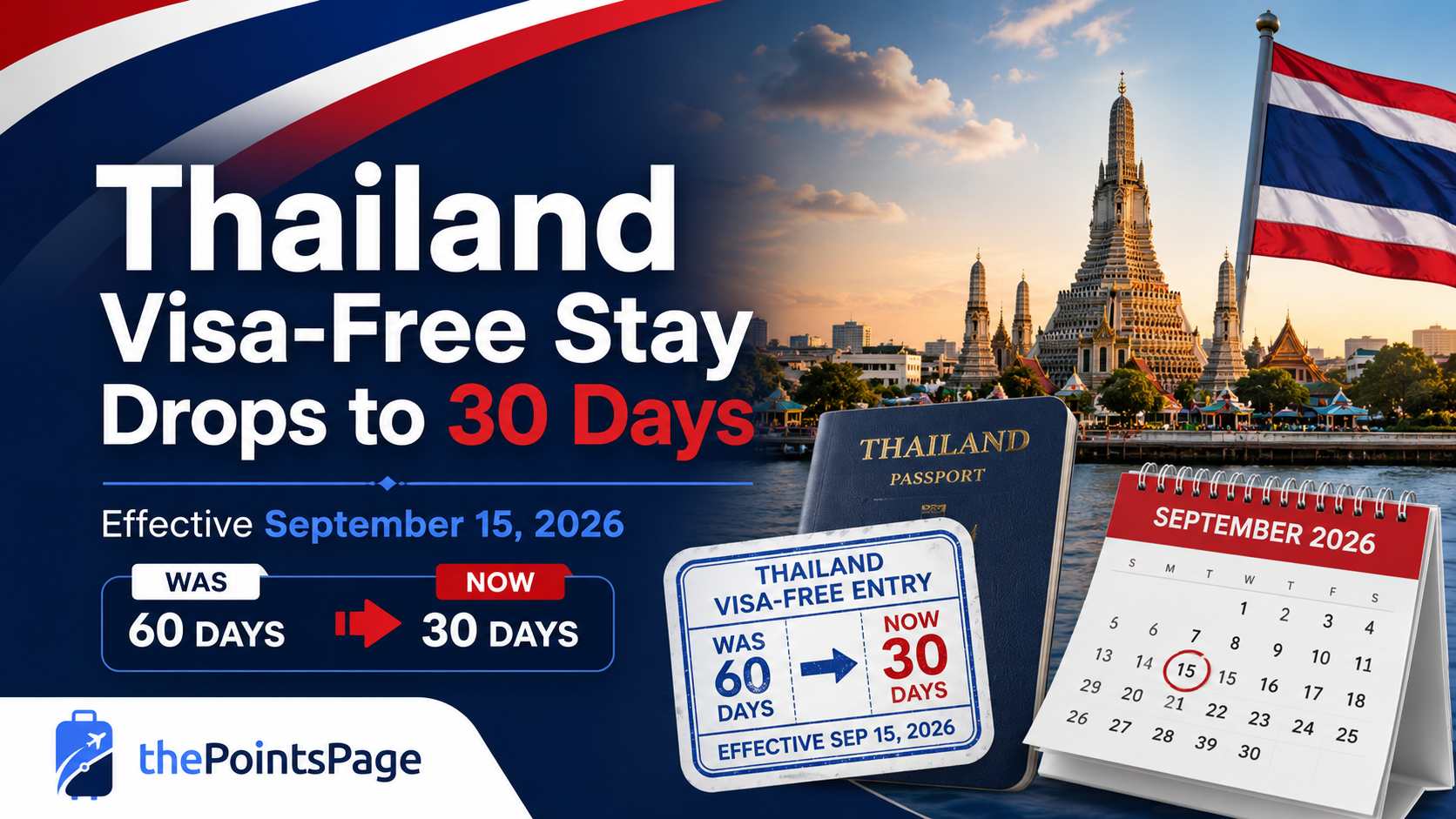
Quick Take: Thailand’s current 60-day visa exemption ends on September 15, 2026. From that date, U.S., Canadian, British, Australian and dozens of other eligible passport holders can still enter visa-free for tourism, but the permitted stay drops to no more than 30 days. The final Royal Gazette framework covers 60 countries and territories at 30 days, gives Mauritius and Seychelles 15 days, and moves Azerbaijan, Belarus and Serbia to Visa on Arrival. Your passport and arrival date determine the rule. Recheck the official list, complete the free Thailand Digital Arrival Card within three days before arrival and arrange the correct visa in advance if 30 days won’t cover the trip.
Thailand just made a two-week difference matter.
The country’s widely used 60-day visa exemption is ending on September 15, 2026. For many travelers—including U.S. passport holders—the replacement still allows a tourism visit without obtaining a visa first, but the maximum stay falls to 30 days.
A normal vacation probably fits without any change. A long points trip, winter escape, remote-work stay or multi-country itinerary may not. If Thailand is the place where you planned to slow down for five or six weeks, it’s time to count the days and stop treating “visa-free” as another word for “no rules.”
What Changes on September 15
Thailand published the final Ministry of Interior announcements in the Royal Gazette on August 31, 2026. The Tourism Authority of Thailand says the new framework takes effect September 15 and replaces the special 60-day exemption introduced in 2024.
There are now several different buckets:
- 30-day visa exemption: 60 countries and territories, including the United States, Canada, the United Kingdom, Australia, New Zealand, Japan, India and all 27 European Union countries.
- 15-day visa exemption: Mauritius and Seychelles.
- Visa on Arrival: Azerbaijan, Belarus and Serbia.
- Separate arrangements: Some passports remain governed by bilateral or other agreements that can provide 90, 30 or 14 days.
That last category is important. The old 60-day program covered 93 countries and territories, while the new 30-day list contains 60. A passport missing from the new list doesn’t automatically mean its holder needs a visa; a separate bilateral agreement may control instead. Don’t borrow the answer from a friend with a different passport.
Use your arrival date, not your booking date: The new rules apply from September 15, 2026. Thailand’s government said travelers admitted before the revised framework takes effect may keep the period already granted under the earlier rules. Check the “admitted until” date placed in your record at entry and don’t assume a September 14 arrival and September 15 arrival produce the same stay.
What This Means for U.S. Travelers
The United States is on Thailand’s new 30-day visa-exemption list. A U.S. tourist arriving on or after September 15 can therefore enter without applying for a tourist visa first, provided the trip fits the exemption and the traveler satisfies the entry requirements.
The U.S. State Department’s Thailand page still described a 60-day visa-free stay when checked on September 1. That guidance matched the rule in force that day, but it hadn’t yet incorporated the September 15 change. This is a useful reminder that even official travel pages can update on different schedules. For the new effective date and nationality list, use Thailand’s Royal Gazette and Tourism Authority announcement, then check again shortly before departure.
The State Department says a U.S. traveler should have a passport valid for at least six months from entry and one blank passport page. It also warns that Thai immigration officials or airline staff may ask to see an onward or return ticket and evidence of sufficient funds.
Meeting those document requirements doesn’t guarantee admission. Visa exemption lets an eligible traveler seek entry without a visa; the immigration officer still decides whether to admit the traveler and for how long.
Thirty Days Isn’t the Same as Thirty Hotel Nights
Don’t look only at the number of hotel nights. Your permitted stay is the date authorized by immigration, and the arrival day matters. Overnight flights and late-night arrivals also make casual mental math unreliable.
For any trip close to the limit:
- Write down the date the flight lands in Thailand, not the date it leaves home.
- Count the complete itinerary conservatively, including arrival and departure dates.
- Confirm the permission stamped or recorded at immigration.
- Leave a buffer for a cancelled or rescheduled departure.
A legal stay that ends on the same day as your only flight home leaves no room for a mechanical delay, weather cancellation or schedule change. A little slack is much cheaper than trying to solve an immigration problem at the airport.
Staying Longer Than 30 Days Requires a Better Plan
If the itinerary exceeds the exemption, the clean answer is to identify the proper visa before departure. Thailand’s official e-Visa website lets travelers check whether a visa is required based on passport, travel document and planned stay, then apply online when eligible.
The Royal Thai Embassy in Washington currently says a single-entry tourist visa allows a stay of up to 60 days. For applications under its jurisdiction, the embassy advises applying at least 30 days before departure but generally no more than 90 days in advance. Processing can take longer during busy periods, and an application doesn’t guarantee approval.
An extension may be possible in some circumstances, but approval belongs to Thai immigration. Don’t build a nonrefundable 45-day trip around the assumption that an officer will extend a 30-day admission after you arrive.
Don’t Turn a Border Run Into the Plan
The new framework generally limits use of the 30-day exemption at land-border immigration checkpoints to two entries per calendar year. The published exceptions include nationals of Malaysia, Brunei Darussalam, Indonesia and Singapore, along with any other nationalities the minister may designate.
That rule is specifically written for land-border entries, but repeated entries by any route can still attract questions about whether a traveler is genuinely visiting for tourism. A cheap award to a neighboring country doesn’t convert the exemption into a long-stay visa.
The Thailand Digital Arrival Card Is Separate
The Thailand Digital Arrival Card, or TDAC, remains required for non-Thai nationals entering by air, land or sea. The Royal Thai Embassy says it must be completed online within three days before arrival.
The TDAC isn’t a visa and doesn’t extend the permitted stay. It’s an arrival registration. Submit it through the official Thailand Immigration Bureau portal, which states that no fee is required.
Your Pre-Flight Thailand File:
- Passport and a copy stored separately.
- TDAC confirmation from the official free portal.
- Onward or return itinerary.
- First accommodation address and reservation.
- Visa confirmation if the trip needs one.
- Travel-insurance policy and emergency contacts, when purchased.
Be especially careful with look-alike arrival-card websites. A third party may charge for help submitting information that the government accepts for free. Starting from the official immigration domain avoids an unnecessary fee and reduces the amount of passport data shared with another company.
Check Every Reservation That Crosses the New Date
The rule change doesn’t cancel your flight or hotel automatically. It changes the immigration permission attached to the traveler, so the burden is on you to make the itinerary legal.
Review these bookings now:
- Award flights: Confirm the actual arrival date, departure date and change or cancellation rules.
- Separate tickets: Make sure the onward reservation is confirmed and leaves enough connection time.
- Hotels: Check the cancellation deadline before shortening a stay. A points booking can still carry a cash late-cancellation fee.
- Tours and transfers: Move or cancel activities that fall outside the revised itinerary.
- Travel insurance: Read the policy rather than assuming a government rule change creates automatic coverage.
The free thePointsPage Travel Planning Checklist is useful here because it keeps arrival dates, hotel deadlines, ticket rules and documents in one place. The Tools of the Trade guide can help if the trip has enough reservations that email alone is no longer a safe tracking system.
What to Do if Your Existing Trip Is 31 to 60 Days
- Check the passport: Confirm the exact entry category that will apply on the day you arrive.
- Find the authorized duration: Don’t assume every nationality moves to 30 days; bilateral rules may apply.
- Price the correct visa: Use Thailand’s official e-Visa site and the embassy or consulate serving your residence.
- Compare changing the trip: Review award redeposit fees, cash-fare differences, hotel penalties and tour refunds.
- Protect the departure: Avoid an itinerary with no buffer before the permitted stay ends.
- Save the evidence: Keep the visa or exemption guidance, TDAC, ticket confirmations and entry record accessible offline.
If the change makes part of the trip nonrefundable, document the original booking date, the new government announcement and every response from the airline, hotel or insurer. Coverage and waivers depend on the applicable terms. The Credit Card Travel Protections guide identifies which benefit guide to read, while the Travel Insurance Fit Check helps compare whether broader standalone protection is worth considering for a future trip.
Getting to the Point(s)
Thailand is still visa-free for short tourist visits by U.S. passport holders and many other travelers. The difference is that “short” means no more than 30 days for arrivals beginning September 15—not the 60 days people have become used to since 2024.
Most one- or two-week vacations won’t need a new plan. Longer stays do. Check the rule for your passport, count from the actual arrival date, apply early if a visa is necessary and complete the free TDAC close to departure.
The flight award may be the hardest reservation to find, but it isn’t the first thing that decides whether you can take the trip. Entry permission comes before seat selection.
Put the Entry Rules Beside the Reservations
Use the free planning checklist to track passport requirements, arrival forms, flight dates, hotel deadlines and backup plans. For a costly international trip, compare the coverage you have before assuming points, cards or a policy will solve every disruption.
Sources & Further Reading
- Tourism Authority of Thailand — New Visa-Exemption Rules Effective September 15
- Royal Gazette of Thailand — Ministry of Interior Announcements Published August 31, 2026
- Royal Thai Government — Cabinet Review of Visa-Exemption Categories
- Royal Thai Embassy, Washington — Visa Information and TDAC Guidance
- Royal Thai Embassy, Washington — Single-Entry Tourist Visa
- Thailand Ministry of Foreign Affairs — Official e-Visa Portal
- Thailand Immigration Bureau — Official Free TDAC Portal
- U.S. Department of State — Thailand International Travel Information
- LoyaltyLobby — Thailand Reduces Visa-Free Entry Allowance
- MilesFeed — Points and Miles News Feed
This article reflects information available on September 1, 2026. Entry rules depend on nationality, passport or travel document, purpose, arrival method and date. Visa exemption doesn’t guarantee admission, and an extension is never automatic. Government pages may update on different schedules. Confirm the current rule with Thailand’s official immigration, e-Visa, embassy or Tourism Authority sources before travel.
🇹🇭 Thailand’s 60-day visa exemption ends September 15. For U.S. travelers and many other eligible passport holders, the new limit is 30 days.
[[TPP_BLANK_LINE]]
Most vacations still fit. Longer points trips, winter stays and remote-work plans may need a visa or a different itinerary.
[[TPP_BLANK_LINE]]
📅 Count from the actual arrival date
🛂 Check the rule for your passport
📝 Complete the free TDAC within three days of arrival
✈️ Keep an onward ticket and some schedule buffer
⚠️ Don’t assume a border run fixes a long stay
[[TPP_BLANK_LINE]]
Here’s what changes and the reservations to check now:
https://www.thepointspage.com/thailand-visa-free-stay-30-days-september-2026/
🇹🇭 Thailand’s visa-free stay changes on September 15.
[[TPP_BLANK_LINE]]
📅 60 days becomes 30 for many travelers
🛂 Check the rule for your passport
📝 Complete the free TDAC before arrival
✈️ Review flights, hotels and onward travel
⚠️ Leave a buffer before your permitted stay ends
[[TPP_BLANK_LINE]]
#ThailandTravel #VisaFreeTravel #TravelPlanning #AwardTravel #PointsAndMiles #TravelTips
[[TPP_BLANK_LINE]]
Read the full details at thePointsPage.com. Link in bio.
Thailand’s special 60-day visa exemption ends September 15, 2026. The replacement gives passport holders from 60 countries and territories—including the United States—up to 30 days visa-free for tourism.
[[TPP_BLANK_LINE]]
The practical risk isn’t a normal vacation. It’s the longer trip booked under the old assumption, especially when award flights, prepaid hotels and separate onward tickets are involved.
[[TPP_BLANK_LINE]]
Here’s the new framework and a checklist for reviewing existing reservations:
https://www.thepointspage.com/thailand-visa-free-stay-30-days-september-2026/
Thailand’s 60-day visa exemption ends Sept. 15. Many travelers, including Americans, will get 30 days. Check longer trips now.
[[TPP_BLANK_LINE]]
https://www.thepointspage.com/thailand-visa-free-stay-30-days-september-2026/