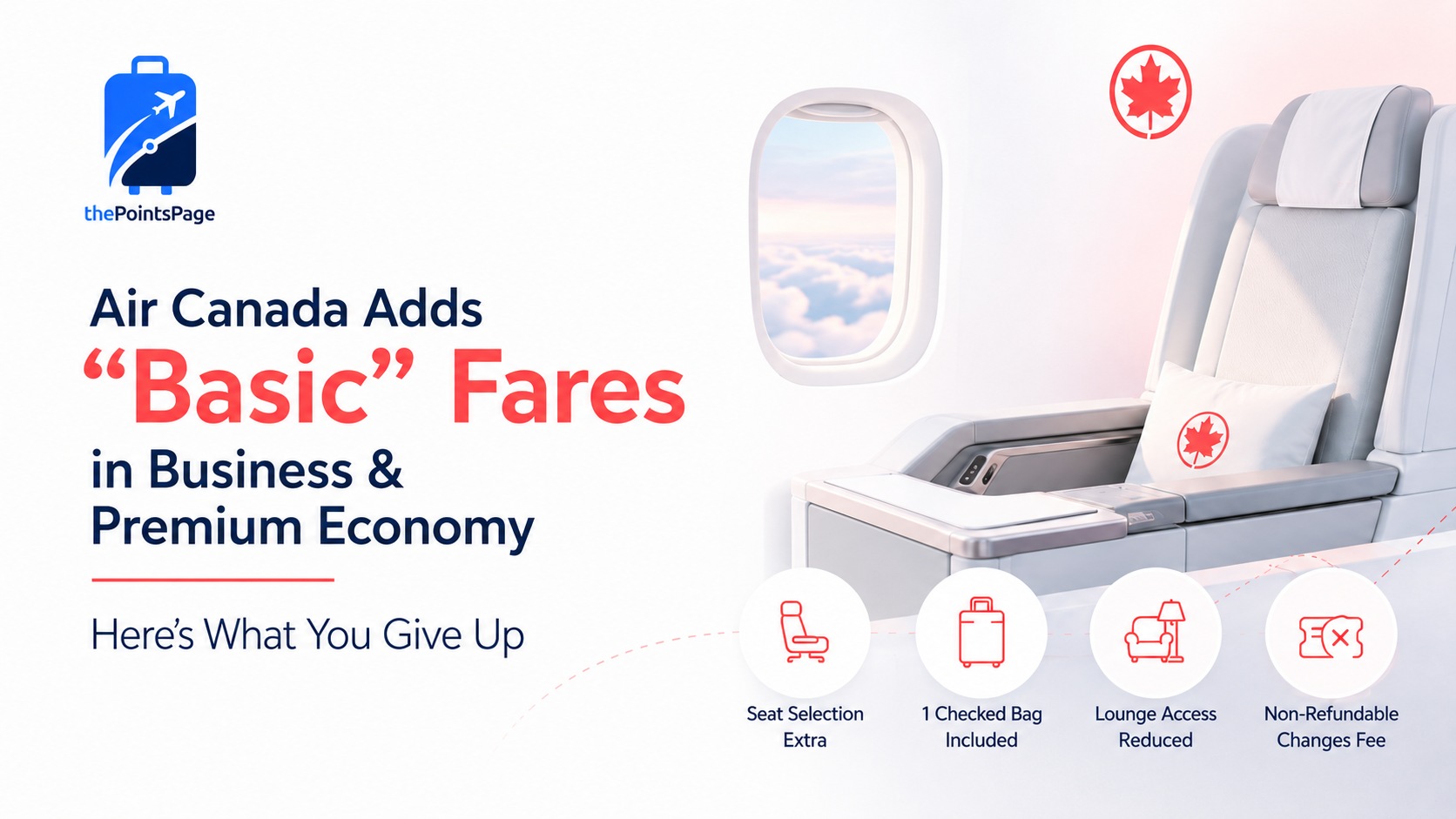
Quick Take: Air Canada has introduced lower-priced Basic fares in Premium Economy and Business Class on select international routes. You’ll still get the premium seat, onboard meal and priority airport treatment, but the trade-offs can include paid advance seat selection, only one included checked bag, no refund and reduced lounge privileges. Don’t assume “Basic” is a bargain until you compare the final price and restrictions with Standard.
Airlines have spent years teaching travelers to slow down before buying basic economy. Now that same homework is moving toward the front of the plane.
Air Canada began selling Premium Economy Basic and Business Class Basic fares on July 28, 2026. These tickets preserve the part most travelers care about—the premium cabin itself—but strip back several benefits people usually expect when paying for a more expensive seat.
That doesn’t automatically make them bad fares. A solo traveler who wants a better seat and won’t change the trip may be perfectly happy with one. But the word “Business” no longer tells you everything that’s included, and the cheapest premium fare on the screen may not be the best value once the restrictions matter.
What Air Canada’s New Basic Fares Include
Both new fares retain Air Canada’s core premium onboard experience. Premium Economy Basic passengers still sit in Premium Economy, while Business Class Basic passengers still receive the Business Class seat and service offered on their aircraft and route. The fare also includes a complimentary meal, a carry-on allowance, priority boarding and priority baggage handling.
The airline is also including one complimentary checked bag with each Basic premium fare. That sounds reasonable until you compare it with the more generous baggage allowance travelers may associate with a regular premium ticket. If you’re traveling with more luggage, include the added bag cost in your comparison instead of looking only at the headline fare.
There’s an important lounge distinction, too. Premium Economy Basic doesn’t include lounge access. Business Class Basic includes access to eligible Maple Leaf Lounges, but it doesn’t include Air Canada Signature Suite access. Travelers who receive lounge access or baggage benefits through Aeroplan elite status, Star Alliance Gold status or an eligible Aeroplan credit card may still receive the benefits attached to that separate qualification.
What You Give Up for the Lower Fare
The biggest restrictions sound a lot like basic economy. Premium Economy Basic and Business Class Basic are nonrefundable, although changes are permitted for a fee. Advance seat selection also costs extra.
That seat-selection rule matters more than it may initially appear. In Premium Economy, a couple could end up paying more to sit together. In Business Class, travelers may care whether they receive a window, aisle, true solo seat or a seat closer to the galley. The quality of the onboard product hasn’t changed, but your ability to choose your place in that cabin has.
Before you buy: Compare Basic with Standard on the exact itinerary. Check the seat-selection charge, baggage allowance, change fee, refund rules and lounge access before deciding that the lower displayed fare is actually cheaper for the trip you’re taking.
Air Canada hasn’t published one universal dollar amount for the savings, seat-selection cost or change fee. Those figures can vary by itinerary and market, so there isn’t a reliable rule like “Business Class Basic is always $200 less.” The only useful comparison is the one shown during your own booking.
Where the New Fares Are Available
At launch, Air Canada says the new Basic premium fares are available in eligible markets covering the Caribbean, Mexico, Latin America and South America, along with transatlantic joint-venture markets involving United Airlines and Lufthansa Group. Iran, Israel and the United Arab Emirates are excluded.
Domestic Canada, transborder U.S.–Canada and transpacific itineraries weren’t identified as launch markets. Availability can also vary by flight, so you shouldn’t expect a Basic premium option to appear on every Air Canada search.
The existing premium fares aren’t disappearing. Air Canada is renaming the previous “lowest” premium fares as Standard and the flexible options as Latitude. That makes the comparison clearer in theory: Basic is the most restrictive, Standard restores more of the traditional fare benefits, and Latitude is the more flexible choice.
What Happens With Aeroplan Points and Elite Credit
These are paid fares, not a new category of Aeroplan award ticket. Members purchasing an eligible Basic premium fare earn one Aeroplan point per eligible dollar spent on the base fare and carrier-imposed surcharges. Elite members can receive the applicable points multiplier tied to their status.
The fares are also reported to earn four Status Qualifying Credits per eligible dollar, consistent with Air Canada’s other Premium Economy and Business Class fares. However, eUpgrades can’t be applied to the new Basic fare types.
If your plan is to book with Aeroplan points instead of cash, the new labels don’t by themselves create a cheaper award. Award availability, points pricing, taxes and partner access still need to be checked separately. The points-and-miles search tools listed by thePointsPage can help you compare options, while the Transfer Bonus Master List can show whether a current bank-to-airline bonus changes the math.
When Business Class Basic Could Make Sense
Business Class Basic is easiest to justify when the fare difference is meaningful and the missing benefits don’t have much value to you. A solo traveler with fixed plans, one checked bag and separate lounge access may sacrifice very little. Someone buying the ticket primarily for a lie-flat seat and overnight rest may care more about the onboard experience than refundability or Signature Suite access.
The calculation changes for families, travelers with uncertain plans, people carrying multiple checked bags or anyone who values a particular seat. In those cases, Standard may be the better purchase even if Basic is the first and lowest price displayed.
This is the same caution that applies to JetBlue’s recently announced BlueFirst Base fare structure: airlines are separating the physical seat from the flexibility and ground benefits traditionally bundled with it. Premium cabins aren’t necessarily getting worse onboard, but premium tickets are getting more complicated to compare.
Don’t Forget the Rest of the Trip
A restrictive fare can be especially risky when it anchors a larger vacation. Before paying, work through thePointsPage’s Award Trip Planning Checklist and review the travel protections on the credit card you’ll use. Card coverage doesn’t turn a nonrefundable ticket into a refundable one, and it only applies when the specific terms and covered reasons are satisfied.
If you’re combining Air Canada with partner awards, positioning flights or a complicated international itinerary, the thePointsPage Award Booking Service can help you compare the moving pieces before you transfer points or commit to restrictive plans.
Getting to the Point(s)
Air Canada’s new Premium Economy Basic and Business Class Basic fares give travelers another price point, but they also make the cabin name less useful as a shortcut. You can still receive the premium seat and onboard service while giving up flexibility, baggage, seat selection or part of the lounge experience.
The real test will be pricing. If Basic creates a meaningful discount, it could be a sensible option for travelers who know exactly which benefits they need. If it simply replaces yesterday’s regular fare while Standard becomes more expensive, it’s unbundling—not a deal.
Read the fare summary all the way through, price the extras you’ll actually use and compare Basic against Standard before clicking purchase. Up front, the cheapest premium ticket may look obvious. After the restrictions are counted, it may not be.
Keep Up With Changes Before You Book
Airline fare rules and loyalty benefits can change quickly. The Runway collects fresh points-and-miles headlines in one place, and the thePointsPage Community is where travelers can compare real booking results and fare-rule data points.
Sources & Further Reading
- Air Canada — International Fare Options and Fees
- Travelweek — Air Canada Launches Premium Economy Basic and Business Class Basic
- Live and Let’s Fly — Air Canada Introduces Basic Premium Fares
- MilesFeed — Daily Points-and-Miles Headlines
Airline fares, fees, baggage allowances, lounge access, loyalty earnings and route availability can change. Review the exact fare conditions shown by Air Canada for your itinerary before purchasing or changing a ticket.
✈️ “Basic” fares have officially reached Air Canada’s Premium Economy and Business Class cabins.
[[TPP_BLANK_LINE]]
You’ll still get the premium seat, meal and priority treatment—but the lowest fare may come with:
[[TPP_BLANK_LINE]]
💺 Paid advance seat selection
🧳 Only one included checked bag
🔄 Change fees and no refund
🥂 Reduced lounge access
[[TPP_BLANK_LINE]]
Business Class Basic could still make sense when the savings are real and your plans are firm. Just compare the complete cost with Standard before booking.
[[TPP_BLANK_LINE]]
Here’s what Air Canada’s new fares include—and what they don’t:
https://www.thepointspage.com/air-canada-basic-premium-fares/
✈️ Air Canada has introduced Premium Economy Basic and Business Class Basic fares.
[[TPP_BLANK_LINE]]
The premium seat and onboard service remain, but the lowest fare can mean paid seat selection, one included checked bag, no refund and reduced lounge privileges.
[[TPP_BLANK_LINE]]
The right question isn’t just “Is Basic cheaper?” It’s “Is it still cheaper after I add what I need?”
[[TPP_BLANK_LINE]]
#AirCanada #Aeroplan #BusinessClass #PremiumEconomy #PointsAndMiles #TravelTips
[[TPP_BLANK_LINE]]
Read the full details at thePointsPage.com. Link in bio.
Air Canada is extending unbundled pricing into Premium Economy and Business Class.
[[TPP_BLANK_LINE]]
Its new Basic premium fares preserve the premium cabin seat, onboard meal and priority airport services, but add restrictions around refunds, advance seat selection, baggage and some lounge access.
[[TPP_BLANK_LINE]]
That may create a useful lower price point for travelers with firm plans. It also means “Business Class” no longer tells you everything included with the ticket.
[[TPP_BLANK_LINE]]
Here’s what travelers should compare before choosing Basic over Standard:
https://www.thepointspage.com/air-canada-basic-premium-fares/
Air Canada now sells Basic fares in Premium Economy and Business Class. The premium seat stays, but refunds, seat selection, bags and lounge access may differ. Compare the full cost.
[[TPP_BLANK_LINE]]
https://www.thepointspage.com/air-canada-basic-premium-fares/