
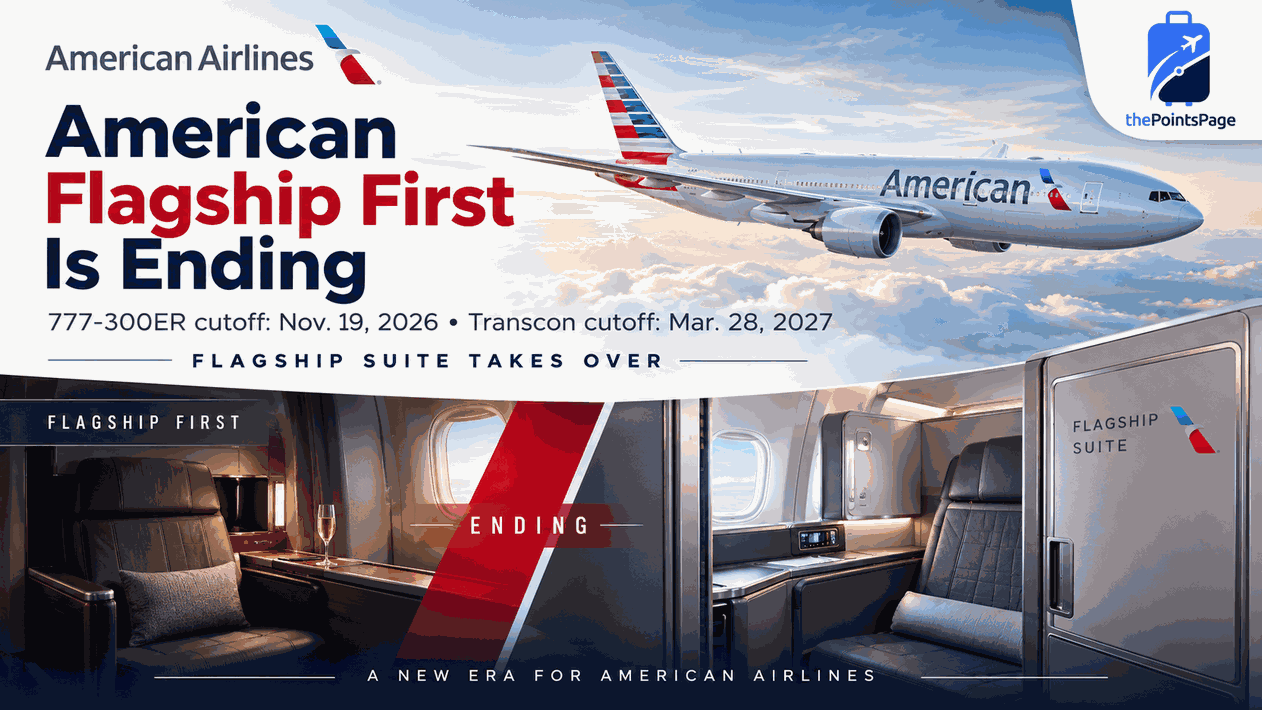
Quick Take: American Airlines has put firm dates on the end of Flagship First. The separate cabin disappears from Boeing 777-300ER travel beginning November 19, 2026, then from transcontinental routes beginning March 28, 2027. It is being replaced by a larger Flagship Suite business-class cabin, not by the disappearance of premium travel. The retrofitted 777-300ER has 70 private-door Flagship Suites, up from 52 business-class seats plus eight First Class seats in the old layout. That creates more business-class capacity, but it also ends American’s most exclusive international cabin. Travelers with First Class tickets or awards beyond the cutoff should monitor the aircraft and seat map rather than assuming the original cabin will remain.
American Airlines is not simply giving Flagship First a new seat. It is eliminating the cabin.
The airline’s first retrofitted Boeing 777-300ER entered service from New York to Buenos Aires on September 2 with 70 Flagship Suite business-class seats and no First Class cabin. American has now attached two hard travel dates to the broader transition: November 19 for the 777-300ER and March 28, 2027, for its premium transcontinental routes.
For most passengers, the replacement is a better and more consistent business-class product with privacy doors. For travelers who specifically booked First—or hoped to redeem miles for it—the change removes a distinct cabin and makes the aircraft assignment much more important.
The Two Flagship First Cutoff Dates
| Travel | Flagship First cutoff | What takes over |
|---|---|---|
| Boeing 777-300ER routes | Not available for travel beginning November 19, 2026 | Retrofitted 777-300ER with one 70-seat Flagship Suite cabin |
| Premium transcontinental routes | Not available for travel beginning March 28, 2027 | Flagship Suite business class as more Airbus A321XLRs enter service |
American describes these as dates when Flagship First will no longer be available for purchase for travel. The first redesigned 777 is already flying, however, so a trip before November 19 doesn’t guarantee the old aircraft. As the 20-aircraft fleet moves through the retrofit program, equipment can change before the formal cutoff.
Domestic First Class isn’t ending: This announcement concerns Flagship First—the separate premium cabin above business class on certain international 777-300ER and transcontinental flights. It doesn’t eliminate the ordinary First Class cabin sold on American’s domestic network.
What Replaces First on the 777-300ER
American’s old 777-300ER layout had eight Flagship First seats, 52 business-class seats and 28 Premium Economy seats. The retrofit removes First and expands the two cabins below it.
| Cabin | Previous 777-300ER | Retrofitted 777-300ER |
|---|---|---|
| Flagship First | 8 seats | Removed |
| Business / Flagship Suite | 52 seats | 70 suites |
| Premium Economy | 28 seats | 44 seats |
| Main Cabin Extra | Separate extra-legroom section | 30 seats |
The new Flagship Suite has a sliding privacy door, more personal storage and a chaise-lounge seating position. American also includes priority airport services, Flagship Lounge access where available, multicourse dining, an amenity kit, a mattress pad and a cool-touch pillow for eligible Flagship customers.
Every 777-300ER is also scheduled to receive free high-speed, gate-to-gate Wi-Fi for AAdvantage members, sponsored by AT&T. That is a meaningful improvement over judging a premium cabin only by the door on the seat.
The aircraft will continue to appear on major long-haul markets including London, Tokyo, São Paulo, Buenos Aires and Sydney. That list describes where American operates the fleet, not a promise that every frequency on each route will have the retrofit on a given day.
What Travelers Gain—and What They Lose
The Gain: Many More Modern Business Seats
Seventy business-class suites is a huge cabin. Compared with the old 52-seat business cabin, the redesign creates 18 additional business seats on each fully retrofitted aircraft. It also adds 16 Premium Economy seats.
That extra inventory could give American more seats to sell, upgrade into or release as awards. It does not guarantee lower prices or more saver-level availability. Airlines decide award inventory and upgrade space independently from the physical number of seats, and American can price its own awards dynamically.
Still, capacity matters. A 70-seat premium cabin gives revenue management more room to work with than a 52-seat cabin, particularly on departures that don’t fill close to travel.
The Loss: A Truly Small First Class Cabin
The eight-seat Flagship First cabin offered something the new business cabin can’t reproduce: scale. Even a very good suite in a 70-seat cabin is a different experience from a quiet eight-seat section with more individualized service.
That distinction matters to travelers who paid a large cash premium or transferred points specifically for international First. The replacement may have a newer door-equipped seat, but “newer business class” and “First Class” aren’t interchangeable products.
American is also simplifying the ground experience around business class. Beginning September 15, Flagship Dining access expands to eligible Flagship Business and Flagship Business Plus customers on qualifying long-haul international, transcontinental and Hawaii routes. The sit-down dining rooms are available at Dallas–Fort Worth and Miami, with Los Angeles scheduled to reopen later in 2026. Access is space-available, so it isn’t a guaranteed table.
What This Means for Award Travelers
The practical shift is from searching for two premium cabins to searching for one. Once First disappears from a flight, AAdvantage and partner programs can only show the new seat as business class, even when the onboard product looks more modern than the First seat it replaced.
More Seats Don’t Mean a Fixed Award Price
American doesn’t publish a simple saver chart for awards on its own flights. The number of suites therefore can’t tell you what an AAdvantage redemption will cost. Compare the mileage price with the cash fare, check nearby dates and look at partner-program availability before moving transferable points.
Partner programs can be especially useful when American releases the inventory they need, but those programs have their own pricing, change rules and transfer times. A points transfer is generally irreversible. Confirm that the exact flight and cabin are bookable before sending rewards into any airline program.
Existing First Class Bookings Need Attention
If you hold a Flagship First cash ticket, award or confirmed upgrade for travel near or after the relevant cutoff, check the reservation now and again after every schedule-change notice. Look for the operating aircraft, cabin label and seat map.
An aircraft swap can move a passenger from First into the new business cabin even if the flight number and departure time stay the same. Don’t rely only on the fact that the reservation still shows a seat assignment. A seat number can survive while the cabin around it changes.
Rebooking, refund and mileage-redposit options depend on how the ticket was issued and what American or the ticketing partner changes. If the itinerary no longer contains the cabin purchased, ask the ticketing carrier to explain the available choices before accepting a replacement itinerary or voluntary change. Save the original confirmation and any notice showing the former cabin.
Check the operating flight, not just the marketing flight number: A codeshare sold by British Airways, Alaska Airlines or another partner can still be operated by American. The American aircraft and seat map determine whether the flight has old Flagship First, the new Flagship Suite or a different business-class seat.
The Transcontinental Change Comes Later
Flagship First survives a few months longer on American’s premium domestic routes. The airline currently advertises the product on select flights between:
- Los Angeles and New York–JFK
- San Francisco and New York–JFK
- New York–JFK and Orange County
- Los Angeles and Boston
- Los Angeles and Miami
Those flights have historically included specially configured A321T aircraft with 10 First Class and 20 business-class seats, although aircraft assignments vary. The A321XLR replacement consolidates those two cabins into one 20-seat Flagship Suite business cabin.
That means the narrowbody transition is different from the 777 retrofit. On the 777, American grows business class from 52 seats to 70. On the A321XLR, it replaces the old two-cabin premium layout with 20 suites—the same count as the A321T’s former business cabin, but without the 10 First Class seats above it.
If a premium transcontinental award has been part of your wish list, March 27, 2027, is the last published travel date before the product disappears. Availability may be scarce, and American can change the aircraft, so treat a First Class booking as a plan to monitor rather than a museum reservation guaranteed to fly exactly as booked.
How to Tell Which Product You’re Booking
- Check the travel date: November 19 controls the 777-300ER cutoff; March 28, 2027, controls transcontinental Flagship First.
- Find the operating aircraft: Look beyond “Flagship” and confirm whether the flight shows a 777-300ER, A321T, A321XLR or another type.
- Open the seat map: A small cabin ahead of business signals the old Flagship First layout. A much larger unified suite cabin points to the retrofit.
- Read the cabin label: “Flagship Suite” is business class. A privacy door doesn’t turn it into a First Class fare or award.
- Check every segment: A connecting itinerary can combine different aircraft and different premium products under one price.
- Recheck before departure: Fleet schedules are operational, not contractual promises. Watch for aircraft swaps and seat changes.
- Document a downgrade: Keep the original ticket, cabin and seat confirmation if American removes First from your booked flight.
The thePointsPage Travel Planning Checklist can keep aircraft details, confirmation numbers and schedule-change reminders with the rest of the trip. If the best program, routing or transfer path is the harder part, the Award Booking Service can help evaluate the options before points move.
Is This a Devaluation?
For a traveler who values access to a separate international First Class cabin, yes: an aspirational redemption option is disappearing. American will no longer offer a product above business class on these aircraft and routes.
For the larger pool of travelers trying to book a lie-flat business seat, the answer is more nuanced. The 777 gains substantially more business-class capacity, the seat gets a privacy door, and eligible Flagship Business travelers gain broader access to Flagship Dining. The experience becomes less exclusive at the very top while potentially becoming more attainable one level below.
The important mistake is treating every “First Class is ending” headline as though American is removing premium cabins altogether. It isn’t. The airline is betting on a larger, stronger business-class product instead of maintaining a tiny cabin above it.
Getting to the Point(s)
American’s Flagship First countdown now has two endpoints: November 18, 2026, is the final day before the published 777-300ER cutoff, and March 27, 2027, is the final day before the transcontinental cutoff.
The replacement is a real upgrade for many business-class flyers. American’s retrofitted 777-300ER carries 70 Flagship Suites with privacy doors, 44 Premium Economy seats and free high-speed Wi-Fi for AAdvantage members. But a better business seat doesn’t preserve the eight-seat First Class experience.
If you already hold Flagship First, save the original booking and monitor the aircraft. If you’re shopping for an award, search business class on the new layout and compare programs before transferring points. The cabin name, aircraft and seat map now matter as much as the route.
Build the Award Around the Actual Seat
A premium-cabin label doesn’t tell the whole story. Get help comparing aircraft, award programs, transfer options and backup routings before committing your points.
Sources & Further Reading
- American Airlines — Retrofitted Boeing 777-300ER and Flagship First End Dates
- American Airlines — Expanded Flagship Dining Access
- American Airlines — Flagship First Transcontinental
- AirlineGeeks — American Sets End Dates for Flagship First
- MilesFeed — Points and Miles News Feed
This article reflects information available on September 8, 2026. American can change aircraft assignments, retrofit timing, routes, cabin inventory, award pricing, lounge access and onboard amenities. Published cutoff dates describe when Flagship First is no longer available for purchase for travel on the affected aircraft and routes; they don’t guarantee a particular aircraft before those dates. Verify the operating carrier, aircraft, cabin and current ticket rules before booking or transferring points.
✈️ American Airlines has finally put dates on the end of Flagship First.
[[TPP_BLANK_LINE]]
The separate First Class cabin disappears from 777-300ER travel beginning November 19, 2026, then from premium transcontinental routes beginning March 28, 2027.
[[TPP_BLANK_LINE]]
What replaces it?
🚪 70 private-door Flagship Suites on the retrofitted 777
💺 18 more business-class seats than before
🥂 Expanded Flagship Dining access for eligible business travelers
📶 Free high-speed Wi-Fi for AAdvantage members
⚠️ A new suite still isn’t the same as an eight-seat First Class cabin
[[TPP_BLANK_LINE]]
Here’s what current ticket holders and award travelers need to check:
https://www.thepointspage.com/american-airlines-flagship-first-ending-new-777-suites/
✈️ American Airlines is retiring Flagship First.
[[TPP_BLANK_LINE]]
🗓️ 777-300ER cutoff: November 19, 2026
🗓️ Transcon cutoff: March 28, 2027
🚪 Replacement: 70 private-door Flagship Suites on the retrofitted 777
💺 Business capacity grows, but the eight-seat First cabin disappears
⚠️ Existing First Class travelers should watch the aircraft and seat map
[[TPP_BLANK_LINE]]
#AmericanAirlines #FlagshipFirst #BusinessClass #AwardTravel #PointsAndMiles #TravelNews
[[TPP_BLANK_LINE]]
Read the full details at thePointsPage.com. Link in bio.
American Airlines has set the final travel dates for Flagship First: November 19, 2026, on Boeing 777-300ER aircraft and March 28, 2027, on premium transcontinental routes.
[[TPP_BLANK_LINE]]
The retrofitted 777 replaces separate First and business cabins with 70 private-door Flagship Suites. That means substantially more business-class capacity—and the end of American’s small international First Class cabin.
[[TPP_BLANK_LINE]]
Here’s what changes for cash tickets, award bookings and travelers crossing the retrofit dates:
https://www.thepointspage.com/american-airlines-flagship-first-ending-new-777-suites/
American Flagship First ends on 777 travel Nov. 19 and transcon routes March 28, 2027. Its replacement: a 70-seat, private-door Flagship Suite cabin.
[[TPP_BLANK_LINE]]
https://www.thepointspage.com/american-airlines-flagship-first-ending-new-777-suites/