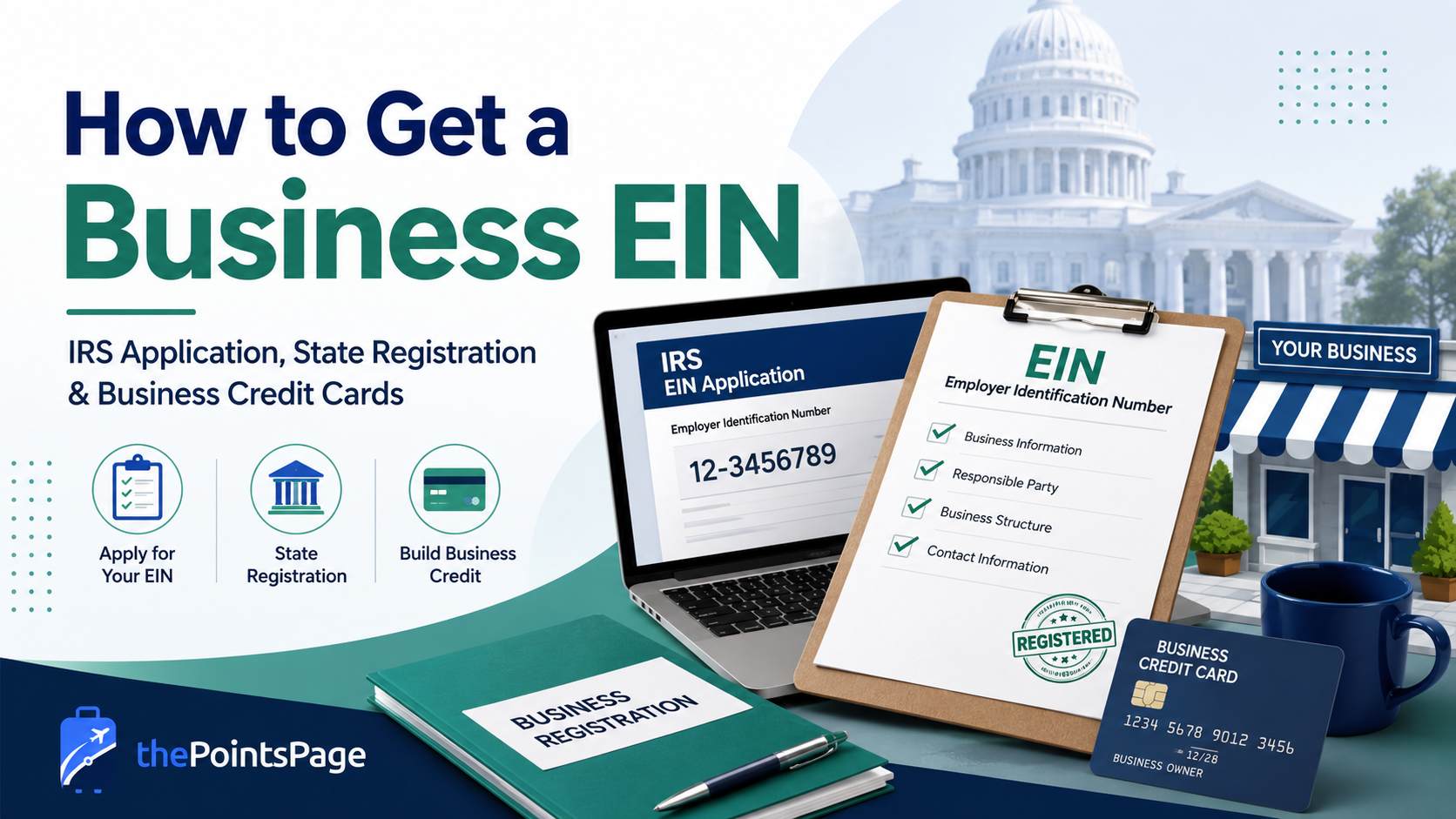
Quick Take: An Employer Identification Number, or EIN, is a federal business tax ID issued by the IRS — not by your state — and applying directly through the IRS costs $0. If you’re forming an LLC, partnership, or corporation, you should generally register that entity with your state first. Your state may then separately require a state tax ID, DBA, sales-tax account, licenses, permits, or other filings. For points-and-miles enthusiasts with legitimate business activity, an EIN can help keep business banking and credit card applications cleaner, but it doesn’t create a business by itself or eliminate the need to provide personal information to a bank.
For a lot of people in the points-and-miles hobby, the first time the letters EIN really get their attention is when they start looking at business credit cards.
Then the questions start.
Do I need an LLC? Does my state issue the EIN? Does it cost money? Do I need employees? Can a side hustle qualify? And does having an EIN somehow mean a bank won’t ask for my Social Security number?
The good news is that the federal EIN process is actually pretty straightforward. The part that gets confusing is separating the federal EIN from whatever your state may require for business registration, taxes, licensing, or permits.
So let’s separate the two and walk through the process in the order I’d actually do it.
First: An EIN Comes From the IRS, Not Your State
An EIN is a nine-digit federal taxpayer identification number issued by the Internal Revenue Service. It’s used to identify businesses and certain other entities for federal tax and reporting purposes.
The IRS says businesses may need an EIN if they have employees, operate as certain entity types, or have specific federal tax obligations. Even when an EIN isn’t required for federal tax purposes, the IRS says a business can still request one for purposes such as banking or state taxation.
That last part is especially relevant for small-business owners, freelancers, consultants, resellers, content creators, rental-property operators, and other people with legitimate business activity.
Review the IRS EIN overview and current application rules.
Important distinction: Getting an EIN does not create an LLC, corporation, partnership, or other legal entity. It also doesn’t provide liability protection. Your business structure and your EIN are two different things.
Step 1: Figure Out Your Business Structure
Before touching the EIN application, figure out what your business actually is.
For many people with a small side hustle, that might simply be a sole proprietorship. You don’t necessarily need an LLC just because you earn a little business income.
If you are creating a formal legal entity such as an LLC, partnership, or corporation, however, the IRS specifically says to register that entity with your state before applying for the EIN.
That order matters because the IRS wants the legal name on the EIN application to match your formation or registration documents.
What if I’m a sole proprietor?
A sole proprietor can still have legitimate business activity without forming a separate LLC or corporation. Depending on what you do and where you live, though, your state, county, or city may still require a DBA, assumed-name registration, tax account, sales-tax permit, or business license.
That’s why “Do I need to register my business?” doesn’t have one universal answer.
Step 2: Check What Your State Requires
Your EIN is federal. State registration is separate.
The Small Business Administration notes that requirements depend on your business structure and location. Some states let you complete registration online, while others may require paper documents through the mail or in person. Most formal entities register through a Secretary of State, business bureau, or similar state agency.
Depending on your situation, you may need to deal with one or more of the following:
- LLC, corporation, or partnership formation
- DBA or assumed-business-name registration
- State tax identification number
- Sales and use-tax registration
- Employer withholding or unemployment accounts
- State, county, or city business licenses
- Industry-specific permits
- Registered-agent requirements for certain entity types
The SBA says the total cost to register a business is generally under $300 in most cases, but the amount varies by state and business structure. A simple business-name registration may cost far less, while other entities and licenses can cost more.
Use the SBA’s state business-registration guide to find your state’s requirements.
You can also use the IRS directory of state government websites to get to the appropriate official state agencies.
A simple order of operations:
- Choose your business structure.
- If you’re forming an LLC, partnership, or corporation, register it with your state first.
- Apply for the federal EIN through the IRS.
- Return to your state and complete any required tax, licensing, employer, DBA, or permit registrations.
- Keep the EIN confirmation and state paperwork with your permanent business records.
Step 3: Apply for the EIN Directly With the IRS
Once you’re ready, you have three primary options as a domestic applicant: online, fax, or mail.
The IRS recommends applying electronically when possible.
Option 1: Apply Online
For most U.S.-based applicants, this is the easiest route.
The IRS online EIN tool is free. You complete the application in one session, and if it’s approved, the IRS can issue the EIN immediately online.
You’ll generally need information such as:
- The legal name of the business or entity
- Your business structure
- The business address
- The reason you’re requesting an EIN
- Information about the responsible party
- The responsible party’s SSN or ITIN
- Basic information about the business activity
The IRS says the online session can’t be saved for later and expires after 15 minutes of inactivity, so have your information ready before you start.
Start with the official IRS online EIN application.
Don’t pay a random website for something the IRS gives you for free. The IRS specifically warns that you never have to pay a fee to obtain an EIN directly from the government.
Option 2: Apply by Fax
You can complete Form SS-4 and fax it to the IRS.
For a business with its legal residence, principal place of business, or principal office in one of the 50 states or Washington, D.C., the current IRS fax number is 855-641-6935.
If you provide a return fax number, the IRS says it generally sends the EIN back in about four business days, although processing delays can happen.
The IRS fee is still $0. Your fax service, if you use one, may charge its own fee.
Option 3: Apply by Mail
You can also complete Form SS-4 and mail it to:
Internal Revenue Service
Attn: EIN Operation
Cincinnati, OH 45999
The IRS says mailed applications generally take approximately four weeks.
Review the current Form SS-4 instructions before faxing or mailing an application.
Can I Apply for an EIN in Person?
For a normal domestic EIN application, the IRS currently lists online, fax, and mail as the available methods. Domestic applicants no longer receive EINs by telephone.
International applicants have separate procedures, including a telephone option when the principal place of business is outside the United States or U.S. territories.
What Does an EIN Cost?
The federal EIN itself is easy:
$0 when you apply directly through the IRS.
The variable costs come from the state and local side of the equation.
You might encounter fees for:
- Forming an LLC or corporation
- Registering a DBA or assumed name
- Annual reports
- Registered-agent services if you choose to pay for one
- Business licenses or permits
- Local registrations
- Sales-tax or other state accounts, depending on the jurisdiction
Some of those may be free. Others may cost hundreds of dollars. That’s why the correct answer isn’t “an EIN costs $___.” The EIN costs nothing; the business setup around it depends on your state and business.
What Can You Use an EIN For?
Once issued, the IRS says an EIN can generally be used immediately for most business needs, including opening a bank account and applying for business licenses.
Depending on your business, it may also be used for:
- Federal tax filings and reporting
- Business bank accounts
- Business licenses and permits
- State tax registrations
- Payroll and employer accounts
- Business credit applications
- Vendor or business paperwork that requests a federal tax ID
There can be a short delay before a newly issued EIN works with certain IRS matching, electronic filing, or electronic tax-deposit systems, so don’t assume every database will recognize it the second it’s issued.
Using Your Business Documents for a Costco Business Membership
This is one of the more practical examples of why I like having the EIN confirmation and state paperwork organized instead of treating them like documents you’ll never look at again.
A Costco Business Membership is specifically designed for people buying products for business, personal, and resale use. Costco currently says a Business Membership applicant must show business identification — such as a business license or three pieces of business ID — and provide a resale certificate when applicable. You can start the membership online, but Costco says you’ll still need to stop at a warehouse membership counter to show the required identification and pick up your cards.
A small but important clarification: Costco’s published rules don’t say that an EIN is universally required for every Business Membership. The stated requirement is business identification, plus the appropriate resale information when applicable. If you have an EIN and a state-registered business, I’d bring your EIN confirmation, state formation or registration documents, business license or DBA paperwork if applicable, valid photo ID, and your resale certificate if you’ll be purchasing for resale. The exact documentation Costco accepts can depend on the business and location.
If your business is buying inventory for resale, the state paperwork becomes even more important. Costco says Business Members purchasing for resale must provide the appropriate resale information, and its membership application instructs applicants to bring a resale certificate when applicable. Costco also says it is legally required to keep copies of business certificates on file.
Where Costco gold reselling fits in
For points-and-miles enthusiasts, this can connect directly to a legitimate resale strategy. Costco frequently sells high-value merchandise, including precious metals, and a real resale business can create substantial business spend. If that inventory is purchased on a rewards card that earns points or helps complete a welcome offer, the rewards can improve the economics of a transaction you were already making for the business.
But I’d never look at the points in isolation. Gold prices move, resale spreads change, inventory and purchase limits change, and the card you use still needs to comply with the issuer’s and merchant’s terms. A resale transaction that loses $150 so you can earn $80 worth of points is still a bad transaction.
If you want to see exactly how I think about that strategy, including the buying, reselling, and manufactured-spend angle, read my Gold Reselling with Costco and Pure guide.
Costco Business paperwork I’d have ready:
- Valid government-issued photo ID
- Your Costco membership confirmation if you signed up online
- Business license or other business identification Costco accepts
- EIN confirmation letter if your business has an EIN
- State formation or registration documents for an LLC, corporation, or other registered entity
- DBA or assumed-name documentation when applicable
- Resale certificate if you’ll be purchasing merchandise for resale
Why an EIN Can Matter in the Points and Miles Hobby
This is where it becomes relevant to thePointsPage readers.
If you have legitimate business activity, separating business income and expenses can make your financial life a lot cleaner. Instead of mixing everything together, you can build a more organized setup:
- Business income goes into the appropriate account.
- Business expenses are easier to identify and track.
- Business banking stays separate from personal banking when appropriate.
- Business credit cards can be used for legitimate business expenses.
- Points and miles become a byproduct of spending the business was already going to do.
That last line is the one I care about most.
The goal shouldn’t be to invent a fake business so you can chase another welcome bonus. The goal is to take legitimate business activity you already have and organize it correctly — and then, if a business rewards card fits, earn points on spending that was going to happen anyway.
Using an EIN on Business Credit Card Applications
Eventually, a lot of readers will land here — and this is where having clean business records can make the application much less confusing.
An EIN can be useful when the bank asks for your business tax identification number, especially if you operate a registered entity or use an EIN for your sole proprietorship. But having an EIN doesn’t mean the bank suddenly stops caring who owns the business.
Business card applications usually have two sides to them: information about the business and information about the person who owns or controls it. For example, Chase’s current guidance for freelancers says an application may ask for the business name, address, annual revenue, number of employees, years in business, industry, legal structure, estimated monthly spend, and an EIN if the business has one. The issuer may also ask for your Social Security number, date of birth, home address, and a personal guarantee.
That’s why the EIN is useful, but it isn’t a magic approval number. The bank is still underwriting the person behind the business in many small-business card applications.
The application fields that trip people up
The questions themselves aren’t usually difficult. The confusion comes from trying to figure out what the bank means by them.
- Business name: Is the bank asking for your own legal name as a sole proprietor, a DBA, or the legal name of an LLC or corporation?
- Tax ID: Should you use an SSN, ITIN, or EIN based on the business structure and what the issuer requests?
- Annual revenue: This means real business revenue — not household income and not a number you think will make the application look better. Some issuer guidance even contemplates a new business with no current revenue.
- Years in business: Use the actual history of the business activity you’re applying under.
- Employees: Don’t count imaginary staff. Depending on the issuer’s wording, you may be the only person working in the business.
- Business category and industry: Pick the description that honestly comes closest to what the business actually does.
- Expected monthly spend: Give a reasonable estimate based on the business, not the size of the welcome bonus you’re trying to earn.
Don’t manufacture the application. You may have a small business. You may have a brand-new business. You may have very little revenue. None of those things automatically mean you should invent numbers. Use accurate information and let the issuer decide whether it fits its underwriting requirements.
My Business Credit Card Application Guide walks through it field by field
I wrote the thePointsPage Business Credit Card Application Guide because this is one of the most common places people unnecessarily talk themselves out of applying — or make an application harder than it needs to be.
The guide is designed to help you think through the application based on how your business is actually structured, whether you’re a sole proprietor using your own name, a sole proprietor with an EIN or DBA, or a formal entity such as an LLC. It also helps explain why the bank may ask for both business information and personal information even though you’re applying for a business card.
Once you understand what each field is asking, the application becomes a lot less mysterious. You’re not trying to find the “right” answer that guarantees approval. You’re trying to give the accurate answer for your business in the format the issuer is asking for.
Not Sure Whether Your Business Activity Could Qualify for a Business Card?
A lot of people hear the word “business” and picture a storefront, payroll, employees, and millions of dollars in revenue. That isn’t the only kind of business activity that can be relevant to a small-business credit card application.
Freelancing, consulting, reselling, photography, tutoring, content creation, online sales, contract work, and other legitimate income-producing activity may all be worth discussing depending on the issuer and the facts of your situation.
If you’re not sure how your legitimate business activity fits into a business credit card application, email me at patrick@thepointspage.com.
Tell me, in general terms:
- What your business or side hustle does
- Whether you operate as a sole proprietor, DBA, LLC, corporation, or other entity
- Roughly how long you’ve been doing it
- Your approximate business revenue and expected card spend
- Which business card or rewards program you’re considering
Please don’t email sensitive information such as your Social Security number, full EIN, bank account numbers, card numbers, passwords, or tax returns.
I can help you understand how your situation may fit the typical application fields, point you toward the relevant application guide or card-selection resources, and — when we have one available — send you a thePointsPage referral link for the card you decide to apply for.
Using a referral link may support thePointsPage at no additional cost to you. A referral link doesn’t improve approval odds, and final eligibility and approval decisions are always made by the card issuer.
Getting to the Point(s)
An EIN sounds much more intimidating than it usually is.
For a legitimate business owner or side hustler, the federal application can be free and quick. The bigger thing to understand is that the EIN is only one piece of your business setup.
Your state may still require you to register an entity, file a DBA, obtain a state tax ID, register for sales tax, get licenses, or complete other filings. Those requirements and costs vary depending on where you operate and what the business actually does.
From a points-and-miles perspective, I’d think of the EIN as an organizational tool first and a credit-card tool second.
Set up the business correctly. Keep the numbers honest. Separate things where it makes sense. Then use the rewards strategy to make the business spending work harder for you.
The business comes first. The points are the bonus.
Ready for the business credit card part?
Once your business information is organized, use the application guide to understand the fields, then run your goals through the Credit Card Selection Tool to narrow down which card may fit your strategy. If you still aren’t sure whether your business activity fits or you want a referral link for the card you choose, send me an email and I’ll point you in the right direction.
Sources & Further Reading
- IRS: Employer Identification Number
- IRS: Get an Employer Identification Number
- IRS: Instructions for Form SS-4
- IRS: Where to File Form SS-4
- U.S. Small Business Administration: Register Your Business
- U.S. Small Business Administration: Get Federal and State Tax ID Numbers
- Costco Customer Service: What is a Business Membership?
- Costco: Business Membership Application & Documentation
- Chase: A Freelancer’s Guide to Business Credit Cards
This article is for general educational purposes and isn’t tax, legal, accounting, or financial advice. Business registration, licensing, resale and sales-tax obligations, Costco documentation requirements, state fees, and credit card requirements vary by location, entity type, merchant, issuer, and individual circumstances. Verify current requirements with the IRS, Costco, your card issuer, and your applicable state and local agencies, and consult a qualified professional when appropriate.
💼 Running a real side hustle, freelance business, resale operation, or small business? An EIN can be a useful next step — and getting one directly from the IRS costs $0.
[[TPP_BLANK_LINE]]
The important part: an EIN is federal, not state-issued. Your state may separately require an LLC/DBA registration, tax ID, sales-tax account, licenses, or permits.
[[TPP_BLANK_LINE]]
I broke down:
🆓 how to get the EIN
💻 online, fax, and mail options
🏛️ what to check with your state
💳 how it fits into business credit card applications
✈️ where it can matter in a points-and-miles strategy
[[TPP_BLANK_LINE]]
https://www.thepointspage.com/how-to-get-a-business-ein/
💼 Have a legitimate side hustle or small business? Getting an EIN directly from the IRS is free — but that’s only one piece of the setup.
[[TPP_BLANK_LINE]]
🆓 Federal EIN: $0
💻 Online application available
🏛️ State registrations and fees vary
💳 Useful when organizing business banking and credit card applications
✈️ Helpful for a cleaner points-and-miles business strategy
[[TPP_BLANK_LINE]]
Read the full details at thePointsPage.com. Link in bio.
[[TPP_BLANK_LINE]]
#thePointsPage #PointsAndMiles #BusinessCreditCards #TravelHacking #SmallBusiness
An EIN is a federal business tax ID issued by the IRS — and applying directly is free. State registration, tax IDs, licenses, and fees are separate and vary by location.
[[TPP_BLANK_LINE]]
This guide explains the correct order of operations, online/fax/mail application options, common state-level requirements, and how an EIN can fit into legitimate business banking and business credit card applications.
[[TPP_BLANK_LINE]]
https://www.thepointspage.com/how-to-get-a-business-ein/
Have a legitimate side hustle or small business? An EIN is free from the IRS, but state registration can be separate. Here’s how to apply and how it fits into business card strategy.
[[TPP_BLANK_LINE]]
https://www.thepointspage.com/how-to-get-a-business-ein/